Solution to Chemical Mystery #17: Bubble Buster!
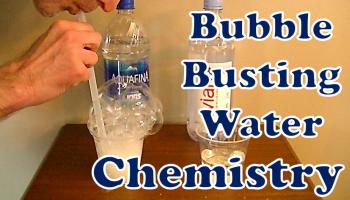
In Chemical Mystery #17, shavings of Dial soap are added to samples of Aquafina and Evian drinking water. Upon blowing into each mixture with a straw, only the Aquafina water produced stable bubbles. Why is this the case?
To understand the difference, first consider that Aquafina water is highly purified, so it contains almost no dissolved ions.1 On the other hand, Evian water contains dissolved Ca2+ (80 mg L-1) and Mg2+ (26 mg L-1) ions.2 It is the presence of these ions in Evian drinking water that prevents the formation of bubbles.
Dial soap is made in part of sodium laurate (NaC12H23O2),3 which is a soluble salt of a fatty acid. Sodium laurate dissolves readily water, forming free sodium ions and free laurate (C12H23O2-) ions:
NaC12H23O2(s) g Na+(aq) + C12H23O2-(aq) Eq. 1
So mixing soap shavings with water causes C12H23O2- to become dissolved in the water; it is the freely dissolved C12H23O2- ions that support bubble formation upon blowing into soapy water through a straw.
Many doubly-charged ions react with C12H23O2- to form a precipitate. Consider, for example, the reactions between Ca2+(aq) and Mg2+(aq) and C12H23O2-(aq):
Ca2+(aq) + 2 C12H23O2-(aq) g Ca(C12H23O2)2 (s) Eq. 2
Mg2+(aq) + 2 C12H23O2-(aq) g Mg(C12H23O2)2 (s) Eq. 3
Because Evian water contains both Ca2+(aq) and Mg2+(aq), any C12H23O2-(aq) that dissolves into Evian water forms Ca(C12H23O2)2 and Mg(C12H23O2)2 precipitates. Thus the C12H23O2- does not remain dissolved in Evian water, which prevents bubble formation. On the other hand, the absence of these ions in Aquafina water means that C12H23O2- remains freely dissolved and available to support bubble formation.
In the video below you can view some experiments that further demonstrate these explanations, and also provide a suggestion or two for further investigation:
Video 1: Tap Water vs. Distilled Water: Sudsing action, Tommy Technitium YouTube Channel, 4/23/20.
These experiments can be related to the concept of solubility of inorganic salts. For example, the reverse of Equation 2 may be written in a form that is familiar when doing Ksp calculations:
Ca(C12H23O2)2 (s) g Ca2+(aq) + 2 C12H23O2-(aq) Eq. 4
Ksp = [Ca2+][C12H23O2-]2 = 6 x 10-13 Eq. 5 (Table 1)
The low value of Ksp for Ca(C12H23O2)2 allows for the prediction that even at low concentrations of Ca2+ and C12H23O2-, precipitation is likely to occur. For example, if enough NaC12H23O2 dissolves in Evian water to form a 0.001 M solution of NaC12H23O2, will precipitation occur?
First we recognize that 80 mg Ca2+ L-1 (the concentration of Ca2+ in Evian water) corresponds to a 0.002 M Ca2+ solution:

Using the reaction quotient, Q, associated with Equation 5, it is calculated that a saturated solution of Ca(C12H23O2)2 results under the stated conditions:
Q = [0.002][0.001]2 = 2 x 10⁻⁹ Q >> Ksp
Therefore, it is no surprise that Ca(C12H23O2-)2 precipitate forms when Dial soap is mixed with Evian water. In the case of Aquafina water, [Ca2+] ~ 0. Therefore, in this case:
Q = [0][0.001]2 = 0 Q < Ksp
And no precipitate is expected.
Bar soaps are comprised of sodium salts of a variety of fatty acids. Ksp values for calcium salts of some fatty acids are listed for the interested reader in Table 1. I was unable to find Ksp values for the corresponding magnesium salts. I would be very interested if someone could alert me to a source that lists Ksp values for magnesium salts of fatty acids or additional calcium salts of fatty acids. However, what I am really interested in is results from variations on this experiment. What other brands of bottled water produce bubbles – or not – when conducting this experiment with Dial bar soap? What happens if you use Ivory bar soap? Do you get the same results when you use dish detergent? If you and your students find something interesting, please let me know in the comments.
Happy experimenting!
Table 1: Ksp values for various calcium salts of fatty acids.4
|
compound |
Ksp |
|
calcium laurate, Ca(C12H23O2)2 |
6 x 10-13 |
|
calcium oleate, Ca(C18H33O2)2 |
1 x 10-15 |
|
calcium palmitate, Ca(C16H31O2)2 |
6 x 10-18 |
|
calcium stearate, Ca(C17H35O2)2 |
2 x 10-20 |
References:
1. https://www.aquafina.com/en-US/faq.html
2. https://www.evian.com/en_us/what-is-spring-water/water-attributes/
3. https://www.in.gov/fssa/thehub/files/dial%20bar%20soap%20with%20vitamins.pdf
4. Peter R. Garret, The Science of Defoaming: Theory, Experiment, and Applications. 2014, CRC Press, Boca Raton, FL, pp. 243-244.

Tom Kuntzleman
I have taught science at all levels from Kindergarten through upper division undergraduate. Member of ACS, AACT.