

Given the success of the first installment of Five for the First, I thought I would write a follow-up column highlighting five more activities I do during the first week of school! These are activities I have used to set up my classes for success. I hope you can find some ideas to bring into the first (or second, or third) week of school to support your classroom culture as well.
Inquiry Cubes
A couple of years ago, I was looking for a new ice breaker, and my friend Alice Putti told me about Inquiry Cubes. I LOVE THEM. They are a great introduction to group work, as well as logic and problem-solving. I also use them to introduce the way I run my class. Like the inquiry cube activity, students typically start class with something familiar and then move through increasingly complex levels that build their knowledge and skills. I also discuss the power of collaborative learning and explain how inquiry can feel frustrating in the moment, but ultimately proves to be fun and more engaging. Students respond really well to the activity and the parallels that I draw between it and the course. Check out this link to get free downloads for the activity.
Lego Building
We are fortunate to have a STEM Resource Lending Service that serves our area, and one of the items I can check out is Lego Learn2Learn sets, which come with a standardized set of Lego bricks in boxes. I assign groups with POGIL roles and have students build a structure of their own creation, then write a procedure for replicating it. They take a picture of their structure and then disassemble it. I have groups trade directions, and then they have to try to replicate the structure for their partner group. I allow them to have three written questions to seek clarification. After this exercise, the groups come together to share feedback, and as a whole class, we discuss the strengths of good procedures and good questions. I find that this activity really sets us up for success in terms of using details in observations and data collection. It’s also a great first use of POGIL roles. I have attached the presentation I developed to guide their work. (See the supplemental materials attached below.) I don’t always schedule two days for this activity, but in the early days of the year, when some classes are impacted by meetings while others are not, it’s nice to have the flexibility of an optional additional day with the activity.
Lab Scavenger Hunt
As an introduction to my room and lab safety, I first show Lab Rules by AsapSCIENCE. Then, I have students create a map of the critical safety features in our classroom. I discuss this further in my Scientific Reasoning Interactive Notebook. This year, I updated the safety features scavenger hunt to include prompts that have them color-code where they go for certain situations. (I have attached a copy in the supplemental material below.) Students get out of their seats and move around to notate a map of the room that I provide. This has significantly increased engagement in my science safety lesson, ensuring that students know what the critical safety equipment items are and where to find them when needed.
This or That CER and debate
I strongly encourage my AP students to use the CER framework when answering free-response questions that ask them to “justify” or “explain”. As an AP Reader, I have seen how powerful this scaffold is in helping students to fully answer all parts of a prompt. As a fun way to introduce CER, I begin my first day of AP Chemistry with "This or That" questions. Students move to one side of the room or the other based on their response. I have a large whiteboard on each side of the room, and once the students have all made a choice, they work together to write a CER supporting their choice. Then each side presents its case, and I choose a winner based on the strength of the CER. I ask students to keep track of how many times they are on the winning side, and the top 3 students (and all ties) get a little prize. This was a fun way to emphasize the usefulness of CER in making a claim.
Some of the questions I used this year were:
- Cats or dogs?
- Roller coasters or water slides?
- Sneakers or sandals?
AP - White Powders Lab CER
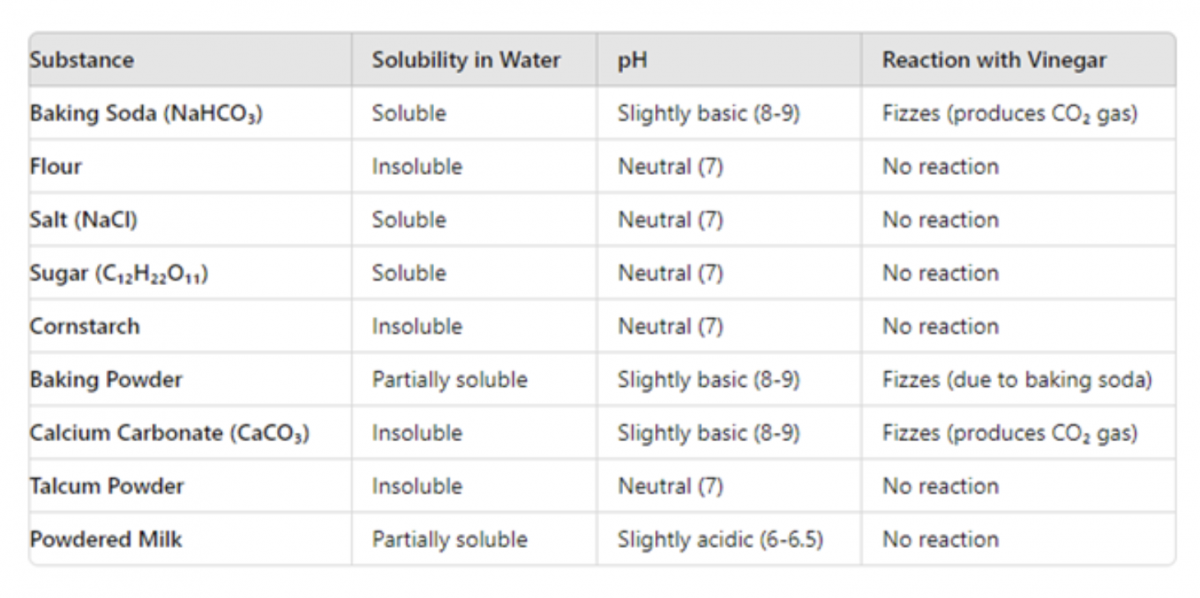
The next day, after conducting the This or That CER debate, my AP students complete a simplified version of the White Powders lab and then justify their choice using CER. All of the powders are safe household items (flour, sugar, baking soda, cornstarch, etc.), and they have to decide which powder they have using simple tests. This is also a simple introduction to inquiry, as they have to design their own procedure. I provide only the table below, pH strips, water, test tubes, and vinegar. To increase engagement with a simple add-on, I inform students that the white powder has been found at a crime scene, and I stretch some crime scene tape across the lab tables.
These activities are great for the start of the school year, but could be used any time throughout the year!
