The Required Skills to Balancing Redox Equations—Logical and Easy
In AP Chemistry, students are introduced to more complex oxidation-reduction reactions, represented by chemical equations1 that are not always easy to balance.
Once the Oxidation Number (ON) concept2 is learned, balancing redox equations is a straightforward process that can be mastered by following what I consider to be a “script”.
While this is hardly a novel approach to balancing redox equations, the supplementary material, especially the PPT lesson, provides a student-ready lesson complete with color-coding and animations.
We will use the following skeleton equation, taken from the supplementary PPT lesson, as an example:
Fe2+(aq) + MnO4–(aq) --> Fe3+(aq) + Mn2+(aq) (occurs in acidic solution—H2SO4)
Step 1. Assign ONs; indicate the species that undergo loss of electrons (LEO = loss of electrons due to oxidation) and gain of electrons (GER = gain of electrons due to reduction).
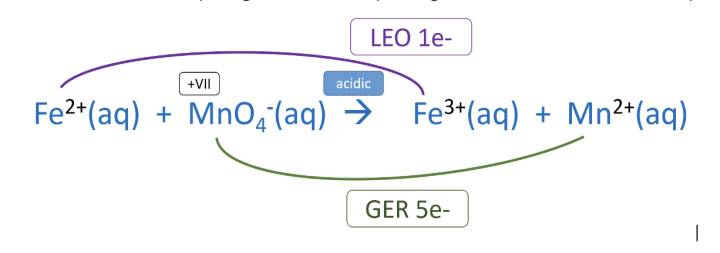
Step 2. Make sure that the quantity of each atom undergoing LEO or GER is the same on each side of the equation.
In this case, there is only one Fe and Mn on each side of the equation. No adjustments need to be made. (See the PPT lesson in the supplementary material for a case where this is necessary.)
Step 3. Equalize the quantity of electrons in each of LEO and GER. In this example, this is accomplished by putting a “5” in front of both Fe2+ and Fe3+.

At this point, the quantity of atoms undergoing LEO and GER, as well as the quantity of electrons lost and gained, has been balanced.
Step 4. To balance the quantity of oxygen atoms on each side of the equation, we add water molecules as appropriate. This is logical—the reaction occurs in an aqueous solution. Here, we need to add four water molecules to the right side of the equation to accomplish this.
Step 5. To balance the hydrogen atoms introduced when we added water molecules, we add the appropriate quantity of H+ ions. Since the reaction occurs in an acidic solution—H2SO4—this is logical.

. . . And we’re done. The equation is balanced.
To check that the equation is balanced:
a) The quantity of electrons LEO and GER are the same (see step 3)—five electrons in this reaction
b) The quantity of each atom is the same on both sides of the equation
c) The total charge on each side of the equation is the same; 17+ in this reaction.
This metaphor of following a “script” to balance redox equations is apt: As an actor interprets a script to create a compelling scene, so a student may have to get creative to balance a more challenging redox equation—but he or she will always stay on script. Again, refer to the supplementary PPT lesson for examples.
- Chemists balance chemical equations; Mother Nature balances chemical reactions.
- Reference my article just published on ChemEd X

Michael Jansen
Academic background: BSc (Chemistry), University of Toronto; MSc (Physical Organic Chemistry), Concordia University, Montreal; BEd/OCT, University of Toronto.