Coordination Compounds: Independent Study
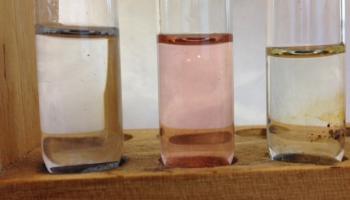
The purpose of this unit is to acquaint you, the student, with some research techniques and to involve you in the discovery learning process. You will be given a topic to work on and some guidelines for what you should accomplish. You will work in groups of three and share your results with the other members of your group.
The problem you will be studying is a classic example of research in chemistry, the structure of a coordination compound. This work led to the first Nobel Prize awarded to an inorganic chemist, Alfred Werner.
The following scientific facts about the compounds of cobalt listed below are well proven and accepted. The overall goal you have is to derive a structure for the three (four?) different compounds that agree with the data. In the process you will learn many new terms but you will also review many ideas and have to adapt them to the new subject matter.
Required Software (as of March 2020, the software has been freely available for an indefinite time because of COVID-19. A ChemEd X subscription may be required after the pandemic.): Werner/Joergensen Bond Theory & Evolution of Bond Theory
Three formulas are known for these compounds.
| Formula | Color of Compound |
|---|---|
| CoCl3·6NH3 | yellow |
| CoCl3·5NH3 | purple |
| CoCl3·4NH3 | one green and one violet |
In addition the following reaction regarding the compounds are known:
| Reaction of Compounds |
|---|
| CoCl3·6NH3 + excess AgNO3 → 3 moles AgCl ppt |
| CoCl3·5NH3 + excess AgNO3 → 2 moles AgCl ppt |
| CoCl3·4NH3 + excess AgNO3 → 1 mole AgCl ppt (both colors do the same) |
Materials
Background
This student activity accompanies the article, A guided group inquiry lesson on coordination compounds and complex ions.
Procedure
Schedule of events
Bring your book everyday for this chapter!
Day One:
Ponder the question and try to devise a structure. Show guess structures to the teacher. Try again.
Day Two:
Use the JCE: Software Programs on the Werner/Joergensen Controversy and on Bonding. Work through these with a partner. Try for another structure based on this information.
Day Three:
Define the following terms (or people) and look up pertinent information.
- complex ion
- coordination compound
- ion counter
- ion
- coordination sphere
- ligand
- molecular geometry
- dative bond isomer
- stereo isomer
- geometric isomer
- ionic bond
- structural isomer
- covalent bond
- lewis base
- Alfred Werner
- chelate
- Mads Jorgensen
Look up the rules for how to name coordination compounds and complex ions. Name the following compounds:
- K2[CoCl4]
- [Cu(NH3)4]SO4
- [FeCl4]−
- K4[Fe(CN)6]
- K2[PtCl4
Write formulas for the following compounds:
- Tetrachloroferrate(II) ion
- Pentammineaquaruthenium(III) ion
- Potassiumamminetrichloroplatinate(II)
- Hexamminecobalt(III) chloride
- Triamminebromoplatinum(II) chloride
Day Four:
Laboratory Exercise on complex ion formation.
Day Five:
Discuss results and review for test
Questions
Concepts
coordination compounds, complex ions
Time Required
5 class periods for entire independent study project
Preparation
provide simulation
Attribution
Michael A. Morgan
Francisco Bravo Medical Magnet High School, Los Angeles, CA 90033
Credits
The author gratefully acknowledges the assistance of Daniel Rabinovich of UNCC with the graphics for this article.
A Bonding Theory/ The Werner-Jorgensen Controversy, A Review of a two part simulation: http://pubs.acs.org/doi/pdfplus/10.1021/ed070p902.1
General
Items tagged with the safety:general tag have some safety concerns that may be also described more specifically by additional safety terms
General Safety
For Laboratory Work: Please refer to the ACS Guidelines for Chemical Laboratory Safety in Secondary Schools (2016).
For Demonstrations: Please refer to the ACS Division of Chemical Education Safety Guidelines for Chemical Demonstrations.
Other Safety resources
RAMP: Recognize hazards; Assess the risks of hazards; Minimize the risks of hazards; Prepare for emergencies

mamorgan@me.com
30 Years of teaching experience at high school and college level. Long time affiliate of the Institute for Chemical Education at UW Madison.