titration

Ramping Up the Disappearing Rainbow with the Assassin’s Water Bottle

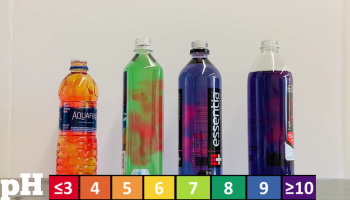
What happens when chemistry and illusion collide? In The Disappearing Rainbow, a simple acid–base demonstration transforms into a spellbinding performance. With a single pour, colorless liquids bloom into a vibrant rainbow—then vanish in an instant. Now, with the arrival of the “Assassin’s water bottle,” this classic demo gets a modern twist that makes the magic easier (and cleaner) than ever.

The Value of Microtitrations

Microtitrations can be used as a stand-alone lesson or as an introduction to more complex titrations. Done without expensive glassware and materials, this alternative to buret titrations is easy to implement in most classroom situations.

KoolAid and similar drinks as convenient laboratory reagents: The weak acid-strong base titration of citric acid or malic acid

The major component of a non-carbonated drink such as KoolAid or a similar beverage is usually a fruit acid, either citric acid or malic acid. The titratable acid (H+) concentration of such drinks has been found to be in the range of 0.02 to 0.04 M. A weak acid-strong base titration of these drinks with 0.1 M NaOH solution is feasible as a student exercise. The use of such drinks as reagents is safe, convenient, and inexpensive. Experiment instructions are included. 

Food Dyes as Acid-Base Indicators

Natural food dyes are being sold online and in stores that can be used as acid-base indicators. These dyes open up a host of possibilities for at-home and in-class. For example, these food dyes can be used as indicators in the quantitative titration of the Mg(OH)2 in milk of magnesia.