Solutions

Solutions and concentration

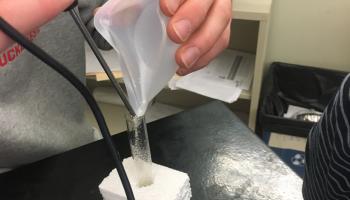
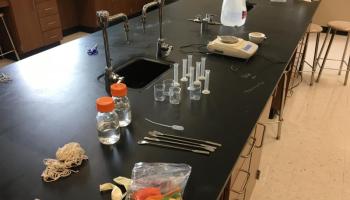
pipetting into a volumetric flask
// Wednesday, January 15, 2020 Joseph Lomax
Two groups of students, typically, have difficulty with titrations, the first time around. Those that act too rashly and overshoot the endpoint, and those over-cautious ones who take forever to finish. I have a nautical analogy that seemed to have helped my groups in my lab recently.
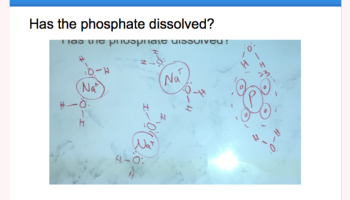
NaCl solubility diagram
// Wednesday, November 13, 2019 Bob Worley
I sometimes wonder why some call precipitation reactions "double decomposition". It is a term I was brought up with in the 1960s. I note that it is still very common in the States. I suppose two (double) salts are sort of splitting apart (decomposing?) and then reforming with other radicals.
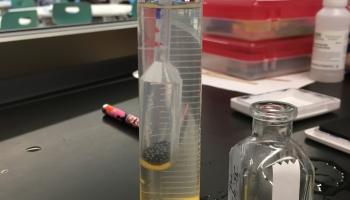
homemade hydrometer in a graduated cylinder with salt water
// Friday, May 10, 2019 Chad Husting
“What are we doing to help kids achieve?”
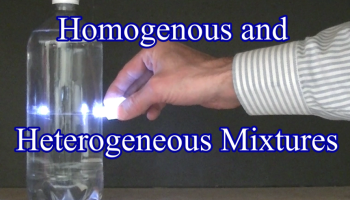
Test for homogeneous vs. heterogeneous mixtures
// Friday, December 1, 2017 Tom Kuntzleman
It looks as though I’ve discovered that density bottles can be used to explore differences between heterogeneous and homogeneous mixtures!
// Tuesday, May 17, 2016 E Posthuma
For my students and me, the AP Chemistry exam does not mark the end of the school year. Once the AP exam is over, my students are exhausted but our class continues to meet for three more weeks. Each year we complete a qualitative analysis lab, but this year we finished earlier than I anticipated. For the first time all year, I have the luxury of time.
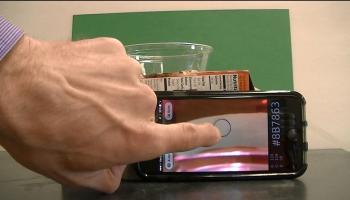
Smartphone spectrophotometer
// Wednesday, March 30, 2016 Tom Kuntzleman
A smartphone can be used in a remarkably simple and inexpensive way to teach your students about absorption spectroscopy and Beer’s Law. In short, light reflected off of colored construction paper is passed through a sample and detected by an RGB application on a smartphone.
// Sunday, November 15, 2015 Chad Husting
What am I doing to help kids achieve?