Redox Reactions

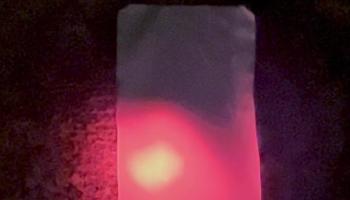
The WEIRDEST Chemical Reaction I've Ever Seen! preview image with octopus icon
// Saturday, September 7, 2024 Tom Kuntzleman
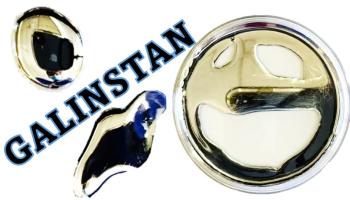
Galinstan is the tradename for a liquid metal alloy that is comprised of three elements: gallium (68.5%), indium (21.5%), and tin (10%).1 It behaves a lot like mercury but has significantly lower toxicity. Because of this, Galinstan is used as a replacement for mercury in a variety of applications.
connecting acid-bases
// Monday, April 1, 2024 Joseph Lomax
Gentle Reader, forgive me if the title - Connecting Acid-Base and Redox Connections (CABARC) - is redundant, but the connections between acid-base and redox reactions already exist, and it is my hope that we as instructors can parlay these connections into easier, better, and deeper understanding of both topics.
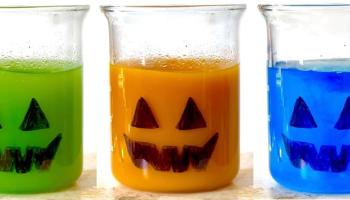
colored solutions in beakers decorated with a Jack-o-lantern face
// Monday, October 17, 2022 Tom Kuntzleman
Co-Authored by Tom Kuntzleman* and Grazyna Zreda** *Spring Arbor University, MI and **Tanque Verde HS, AZ
Galinstan, a liquid metal alloy
// Tuesday, February 22, 2022 Tom Kuntzleman
I have always wanted to try the mercury beating heart experiment, in which a drop of liquid mercury is made to throb like a beating heart.1 However, I have never conducted this experiment due to the issues associated with mercury toxicity.
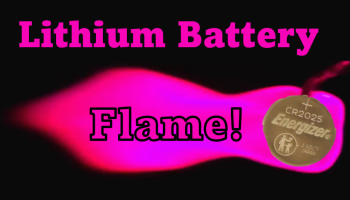
lithium flame
// Monday, September 27, 2021 Tom Kuntzleman
A recent publication in the Journal of Chemical Education caught my eye.1 The article describes how lithium “coin” or “button” batteries can be used in the chemistry laboratory to teach students about stoichiometry.
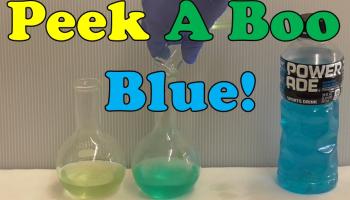
Blue Powerade turning green and yellow
// Wednesday, August 18, 2021 Tom Kuntzleman
In Chemical Mystery #18: Peek A Boo Blue,1 Blue Powerade is observed to change to green, and then to a yellow color. When the yellow-colored solution is disturbed by pouring it, it shifts back to green or blue-green.
green flame
// Tuesday, July 28, 2020 Tom Kuntzleman
Deanna Cullen, Scott Milam, Doug Ragan, and I recently published an article, Rapid Formation of Copper Patinas: A Simple Chemical Demonstration of Why the Statue of Liberty Is Green, in the Journal of Chemical Education1 that describes how to create a blue-green