organic chemistry

Recrystallization in the Organic Chemistry Laboratory.

Implementing a Process-Oriented Guided Inquiry Learning (POGIL) style recrystallization activity provides students with an opportunity to actively engage in the learning process while reinforcing key chemical concepts such as polarity, solubility, and purification techniques. Research has shown that a POGIL approach promotes improved conceptual understanding, critical thinking, and teamwork skills compared to traditional laboratory approaches1,2.

Paper Snowflakes to Model Flat Symmetrical Molecules

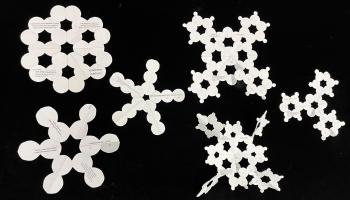
Flat, symmetrical molecules can be modeled by folding a sheet of paper, cutting patterns into the folded structure, and unfolding to produce the flat paper models. The finished models resemble paper snowflakes, but have a variety of rotational symmetries. Template patterns for several molecules are available for download in the Supporting Information.

Thermal Paper as a Polarity and Acidity Detector

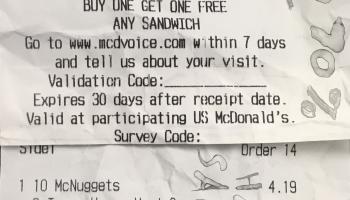
Thermal paper such as that used for point of sale receipts typically functions by darkening when exposed to heat. The pigment system used in this paper also darkens when exposed to solvents of intermediate polarity and acids. This enables thermal paper to be used as an inexpensive sort of indicator paper for a variety of demonstrations.

A Manipulative Paper Tool for Teaching Organic Nomenclature: Part 3- Common Names of Major Classes of Organic Compounds

This is the third in a series of classroom activities using paper tools to teach organic nomenclature. This post covers the two common naming systems used for carboxylic acids and derivatives, and second for alcohols, thiols, ethers, amines, and ketones.

A Manipulative Paper Tool for Teaching Simple Organic Nomenclature: Part 2, IUPAC Naming of Major Classes of Organic Compounds

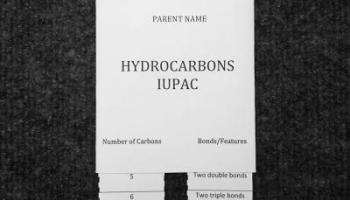
To help introduce students to organic nomenclature in a way that clearly summarizes the patterns that exist in the IUPAC system, a series of paper tools were developed. The paper tool in this activity can be used to introduce the IUPAC naming of major classes of organic compounds. These paper tools are easy to print and distribute to every student each semester.