Latest articles, blogs, and events from the chemical education community

// Saturday, February 20, 2021 Dean Campbell
Years ago, I put on a pair of snowshoes during a winter cold snap and found that the plastic binder straps broke fairly easily. At first I thought the plastic straps had simply become more brittle with time, but I found that the straps became less brittle when brought inside to warmer temperatures.

gas chromatograph wikipedia
// Monday, February 15, 2021 Francisco Villa
Having worked previously at our partner community college teaching Fundamentals of Chemistry (a one-semester introductory chemistry course with lab for non-science majors) and with science majors that transfer over upper division university courses, I have noticed that due to circumstances beyond their control they typically have very limited exposure t
zoom study hall
// Friday, February 12, 2021 Thomas Cox
Think back to when most college students across the country were on campus? I know, it feels like a lifetime ago. But as recently as the Fall 2019 semester, I recall walking through the school cafeteria and observing several groups of students that were clearly studying together.
p-block elements
// Wednesday, February 10, 2021 Joseph Lomax
So I do not need to do as much review, I give my Junior-level Inorganic Chemistry class Review Quizzes. Literally, I give them the quiz a week ahead of time and, with very minor changes, give them the same quiz. I have a tutor session online the night before the quiz and, not surprisingly, they have questions over the quiz. Thus, it becom
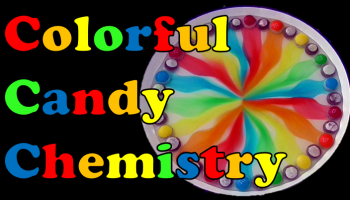
text: Colorful Candy Chemistry
// Monday, February 8, 2021 Tom Kuntzleman
Have you seen the rainbow candy experiment? It's a very simple experiment that involves pouring water into a plate that has M&M's candies or Skittles arranged in a pattern. Very curious shapes of sharply divided regions form spontaneously. How does this happen?! 
text: A Unified Science
// Friday, February 5, 2021 Karen Ye
This self-paced online professional development opportunity features two inquiry-based learning experiences that use familiar and easy to find materials, making these activities suitable for in-person or remote learning.
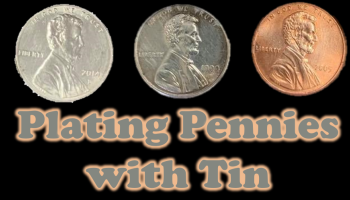
2 silver colored penny and one copper one with text underneath: Plating Pennies with Tin
// Tuesday, February 2, 2021 Tom Kuntzleman
One of my favorite chemistry demonstrations is the “Copper to Silver to Gold” experiment1 (VIDEO 1), in which a penny is first plated with zinc and then heated to form brass, an alloy of copper and zinc. The heat causes zinc to diffuse into the copper in the penny. The zinc plate imparts a beautiful silver color to the penny.