HS-PS3-5: Interactions Between Objects

Students who demonstrate understanding can develop and use a model of two objects interacting through electric or magnetic fields to illustrate the forces between objects and the changes in energy of the objects due to the interaction. 

*More information about all DCI for HS-PS3 can be found at https://www.nextgenscience.org/topic-arrangement/hsenergy


Summary

Students who demonstrate understanding can develop and use a model of two objects interacting through electric or magnetic fields to illustrate the forces between objects and the changes in energy of the objects due to the interaction.

Clarification

Examples of models could include drawings, diagrams, and texts, such as drawings of what happens when two charges of opposite polarity are near each other.

Assessment Boundary

Assessment is limited to systems containing two objects.

Synonyms
PS3-5
NaCl solubility diagram
// Wednesday, November 13, 2019 Bob Worley
I sometimes wonder why some call precipitation reactions "double decomposition". It is a term I was brought up with in the 1960s. I note that it is still very common in the States. I suppose two (double) salts are sort of splitting apart (decomposing?) and then reforming with other radicals.
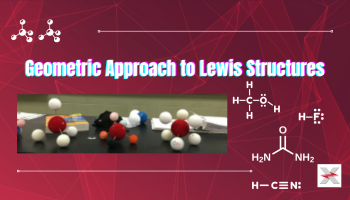
text: Geometric Approach to Lewis Structures (over 3D models and lewis structures)
// Tuesday, April 12, 2016 Lauren Stewart
If you look at any chemistry textbook, you will see Lewis structures introduced long before electronic and molecular geometries. This makes sense since you need Lewis structures to determine molecular geometry.
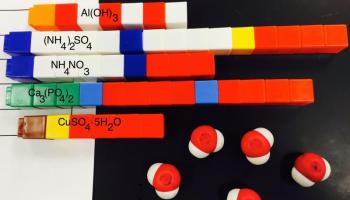
Building Molar Mass, molar mass calculations, mole calculations
// Sunday, May 10, 2015 Doug Ragan
An advantage to teaching on the trimester schedule allows me the opportunity to teach the same course again roughly twelve weeks later.
// Monday, May 13, 2013 Tom Kuntzleman
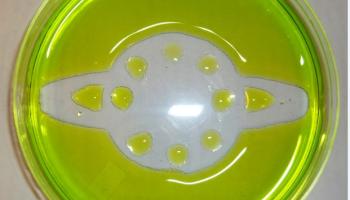
Wow! Talk about an interesting idea! A very neat experiment, called “Hydroglyphics”, has been published by Philseok Kim, Jack Alvarenga, Joanna Aizenberg and Raymond Sleeper in the Journal of Chemical Education.