How a Burning Candle Can Teach Stoichiometry
In 1848 Michael Faraday presented his Christmas Lectures entitled “Chemical History of a Candle” (Hammack and Decoste, 2016). “I cannot imagine a more beautiful example than the condition of adjustment under which a candle makes one part subserve to the other to the very end of its action” - Michael Faraday, 1848 (as cited by Hammack & DeCoste, 2016). Let’s have a burning candle to subserve our teaching of stoichiometry.
In my experience an issue with teaching stoichiometry lies in demonstrating to students the practical application of the calculations they are asked to do. Early in my career I used precipitation reactions to attempt to do this, with students predicting the amount of precipitate produced. However, it’s a long process that lasts a few class periods as the precipitate dries, and the ‘ah ha’ moment that shows what we determined on paper is realized in the lab is often a dud as a result. However, over the past few years I’ve found that using a burning candle, in which students witness mass ‘loss’ in real time, provides a degree of fascination, and they dive into the calculations more readily. Let me explain.
How can the amount of carbon dioxide released in the atmosphere as a result of internal combustion engines be quantified? Video 1, What is carbon dioxide and how does it affect the climate?, details carbon dioxide in the atmosphere and the effect human activities have on it. Students agree that a reasonable headline they read goes something like “X tons of carbon dioxide are released into the atmosphere as a result of internal combustion engines.” But how do we know this? Can we actually measure the carbon dioxide produced? Fortunately, we do not need to. Because chemical reactions are balanced, and mass is conserved, we can measure the amount of candle burned and then determine the carbon dioxide produced and be confident in our answer!
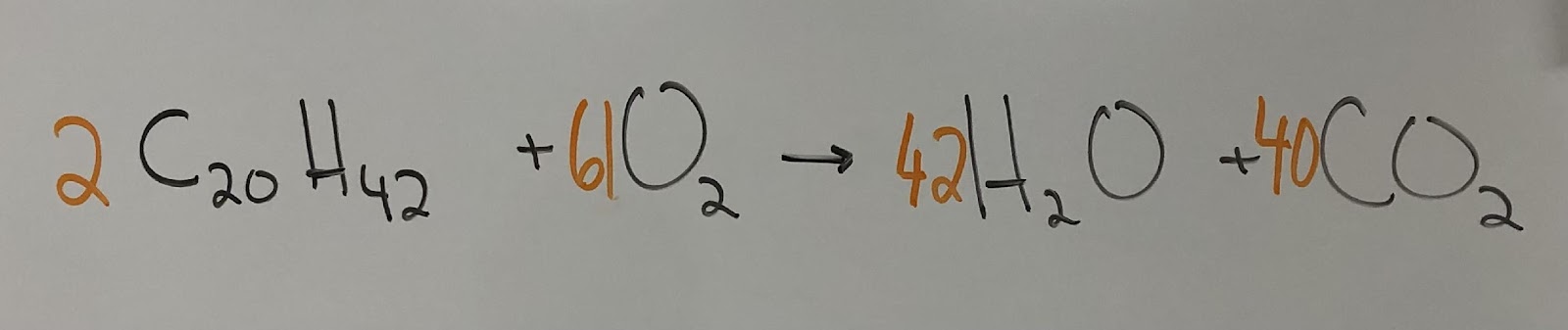
Figure 2. Balanced Equation of Paraffin Wax (icosane).
In this experiment with a candle students are asked to determine the formula of paraffin wax using a Google search. They realize that paraffin is actually a group of alkanes, and I ask them to pick just one to use for their combustion reaction. Typically, they go with C20H42. The balanced chemical reaction is shown in Figure 2. They then place the candle on a watch glass on a balance, recording the initial mass as shown in Figure 3. They light the candle and then take a final mass after a few minutes (three or five work well) as shown in Figure 4. Right before their eyes they watch mass ‘disappear’ and there are usually some ‘oh my gosh’ moments. They are hooked and actually want to perform the calculation at this point.
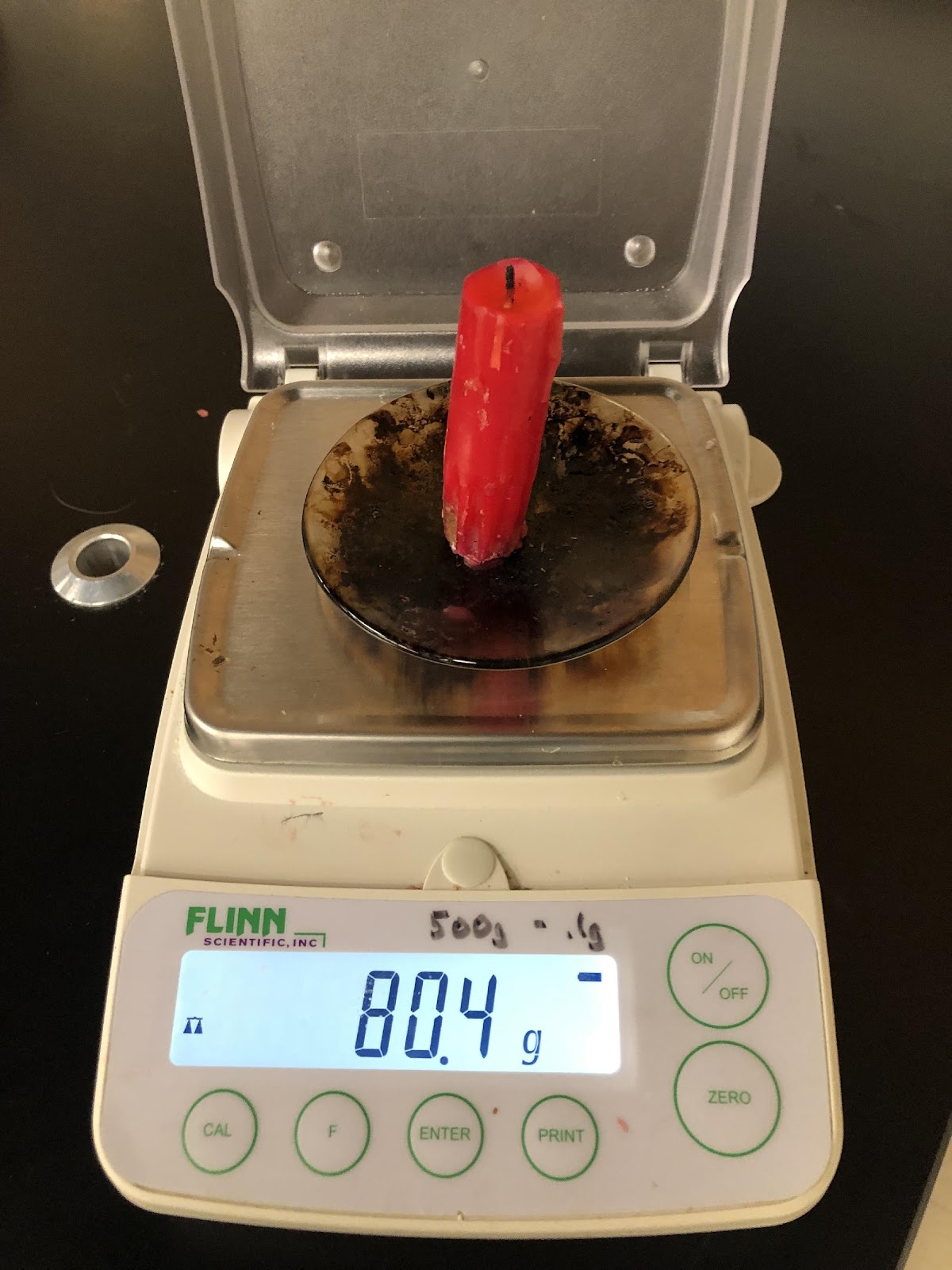
Figure 3. Burning Candle - Initial
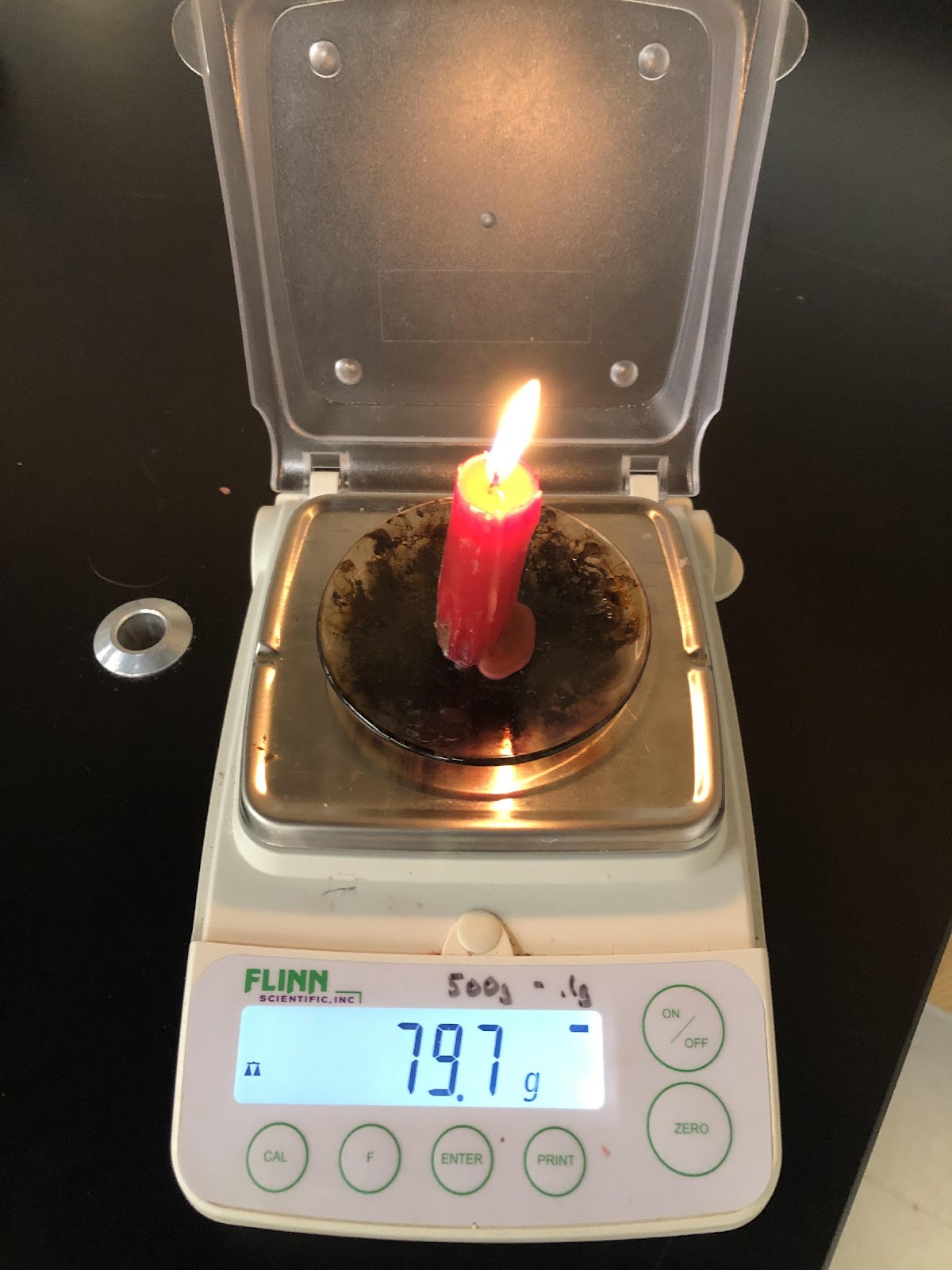
Figure 4. Burning Candle – Final.
Also, they are ready to address the bigger question of how the amount of carbon dioxide produced by internal combustion engines can be quantified. Ask students to research the gallons of gasoline burned in the United States each day (I found 372 million gallons). Assuming gasoline is octane (the ‘number’ on the pump), students can write the balanced combustion reaction. They can research the mass of a gallon of gas (approximately 6 pounds, or 2.72kg), and then calculate the mass of carbon dioxide produced each day in the United States due to gasoline internal combustion engines. It’s a staggering number.
Essential Question: How much carbon dioxide is produced when a candle burns?
Essential Question: How can the amount of carbon dioxide produced by internal combustion engines be quantified?
CITATIONS
- Hammock, B., & DeCoste, D. (2024, May 26). Michael Faraday’s the chemical history of a candle. engineerguy.com. https://engineerguy.com/faraday/pdf/faraday-chemical-history-complete.pdf
- OxfordSmithSchool. (2024, January 10). Part 1: What is CO2 and how does it affect the climate? [Video]. OxfordSmithSchool YouTube Channel. https://www.youtube.com/watch?v=slGpAWOP_-s
- Platt, J. (2020, September 23). CO2 101: Why is Carbon dioxide bad? Treehugger. https://www.treehugger.com/co-why-is-carbon-dioxide-bad-4864246
Materials
- Electronic balance for each lab group/table.
- Watch glass for each lab group/table.
- Candle for each lab group/table. To minimize the change of tipping, candles should be relatively short (10-15cm, for example).
- Matches or lighters for each lab table.
Background
Procedure
- Turn on the electronic balance.
- Place the watch glass on the balance.
- Place the candle on the watch glass so that it stands upright. If it will not, light the candle and allow some wax to drip on the watch glass, then place the candle on the melted wax. This is shown in Figure 3.
- Record the initial mass of the candle.
- Light the candle, allowing it to burn for three minutes. Observe any changes and make note of them.
- Record the final temperature of the candle at the end of three minutes.
- Carefully blow the candle out and let it cool before putting equipment away.
Calculate the mass of carbon dioxide produced from the amount of paraffin that was burned.
SAFETY
- Goggles must be worn.
- Students must take appropriate care with an open flame. Hair should be pulled back. Loose clothing should not be worn.
- The teacher must decide how the candle will be lit – will the teacher do this for each group, or will students light their own candles (matches or lighters)?
Questions
How much carbon dioxide is produced when a candle burns?
Concepts
Time Required
Pre-lab research and formula writing – 15 minutes.
Time in the lab – 15 minutes.
Time to complete calculations and lab report – 15 minutes.
Preparation
Present the Essential Question to students and guide them through the process of writing the balanced chemical reaction (15 minutes of class time).
Set out balances, watch glasses, candles at each lab station (15 minutes prep time).
Put all lab equipment away (15 minutes prep time).
Attribution
N/A
Credits
General
Items tagged with the safety:general tag have some safety concerns that may be also described more specifically by additional safety terms
General Safety
For Laboratory Work: Please refer to the ACS Guidelines for Chemical Laboratory Safety in Secondary Schools (2016).
For Demonstrations: Please refer to the ACS Division of Chemical Education Safety Guidelines for Chemical Demonstrations.
Other Safety resources
RAMP: Recognize hazards; Assess the risks of hazards; Minimize the risks of hazards; Prepare for emergencies

Todd Hollis
After graduating with a BS in chemistry from Bradley University in 1997 I have taught chemistry and physical science, and coached football and track, at Elmwood High School for the past twenty-eight years.