I have just finished teaching bonding to my chemistry classes and was reminded of a brilliant stamp that I have from Russia (technically at the time it was the Soviet Union) that showcases a quadruple bond. Yes you read that right!
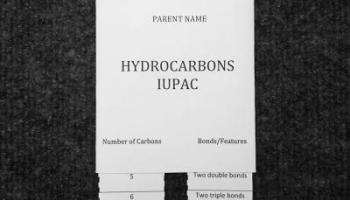
Organic nomenclature is usually taught as part of any introduction to organic chemistry. To help introduce students to organic nomenclature in a way that clearly summarizes the patterns that exist, a paper tool for naming hydrocarbons was developed.
Materials
Materials:
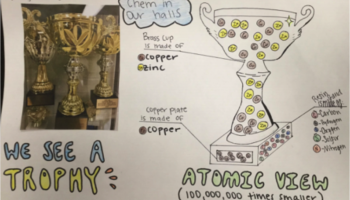
One challenge we encounter in teaching and learning chemistry is connecting the macroscopic and atomic views of matter. Another challenge, complicated by well-meaning but scientifically-weak advertising, is demystifying the word “chemical”.
Back when I started teaching college courses (late 2000s/early 2010s) I was pretty involved in the development of biology and chemistry content for introductory sciences courses that could be used in online, hybrid, and in-person modalities.
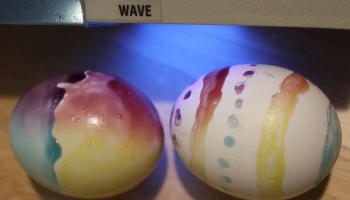
Spring has arrived and parts of the world are experiencing all sorts of color changes in the landscape as the days get longer, plants grow, and flowers bloom. There is a fantastic amount of amazing biochemistry at work in making those colors.
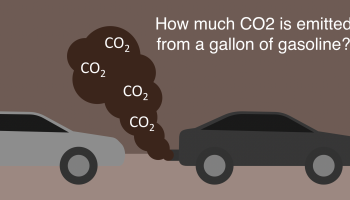
The ideal gas law and gas stoichiometry problems are quite common from the high school chemistry classroom to the college general chemistry laboratory.
If a student “gets the wrong answer” while performing mole conversions, it can be difficult (for both student and the teacher) to discern where an error was made. Inevitably sometime toward the beginning of learning these conversions, students can become overly confident, plugging numbers in without thinking about whether they are sensical. Th
Molecular kits are a large investment for a chemistry classroom and often they only get used once a year during a VSEPR activity. My students love to play with molecular kits as it reminds them of building with LEGOS.
Teaching VSEPR theory presents some unique challenges for students - particularly picturing molecules in 3-D space. I have found manipulatives to be a powerful tool to help students visualize 3-D molecules. Here are some of my favorite manipulatives for teaching VSEPR and cheap at-home modifications for virtual learners.