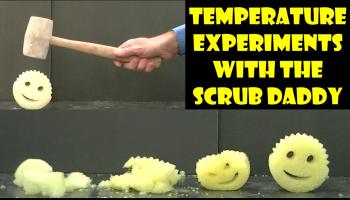
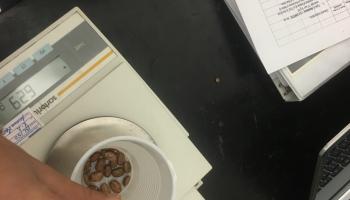
In a previous post, I learned that a Scrub Daddy sponge is mainly comprised of a polymer called polycaprolactone.1 I have continued to gather information on polycaprolactone and also to experiment with Scrub Daddy sponges.
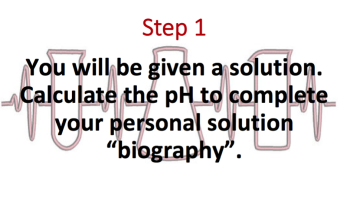
The unit of acids and bases is difficult for most students in Advanced Placement Chemistry. The variety of various calculations can be overwhelming. I decided it was time to make the pH calculations more exciting.
Something about Ben Mecheam's Blog, "Using Evidence to Determine the Correct Chemical Equation: a Stoichiometric Investigation" really got my interest.
In an effort to align my lessons with the Next Generation Science Standards (NGSS), I have tried to take the content I have traditionally taught, and shift the design to focus on student engagement with the science and engineering practice
For a few years now, I have been using a simple laboratory experiment that allows students to calculate the wavelength of various colors of light. I use the activity near the beginning of the semester, when students are first learning about measurement, unit conversions, and significant figures.
For better or worse, I've seen very little of Richard Feynman's work/videos/lectures/etc. But a while ago, somewhere in my Twitter Timeline, somebody mentioned a transcription of a Richard Feynman interview about magnets.
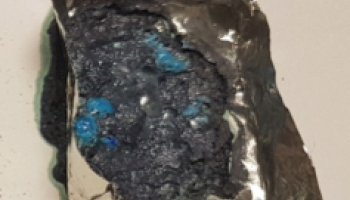
Displacement reactions are an essential way to demonstrate the reactivity series of metals. I have tried many different methods to demonstrate or perform displacement reactions over the years with mixed results regarding one particular metal, aluminium.
The Biennial Conference on Chemical Education is one of the best professional development opportunities available for chemistry educators. The 2018 conference will be held at Notre Dame in South Bend, IN, July 29 - August 3. The ACS Division of Chemical Education sponsors this national meeting. There is excellent programming available for middle school science teachers, high school chemistry teachers, graduate students and college faculty.