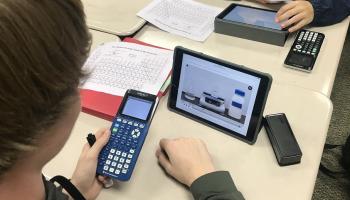
This year, I was presented with an opportunity to join a small cohort of chemistry teachers that would implement, customize, and review interactive video-based lab investigatio
It’s December and social media sites such as Facebook, Twitter, Pinterest, and Instagram are replete with well-meaning teachers asking for Christmas-themed chemistry activities, labs, and demonstrations.
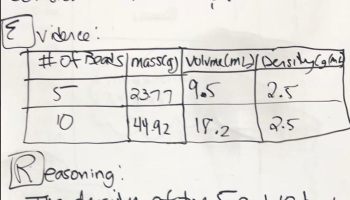
In an effort to implement the science and engineering practices of the NGSS, I have tried to introduce argumentation as a practice into my chemistry courses.
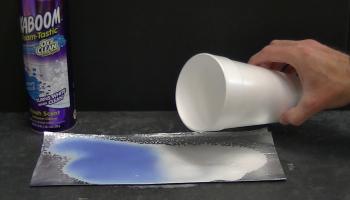
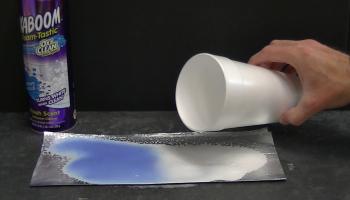
In Chemical Mystery #13, the contents of a "magic" cup were poured over a blue-colored cleaner. As a result, the color of the cleaner immediately changed from blue to white. In another case, the color change occurs when the magic cup is simply held over the cleaner.
A diamond is forever…at least that’s how the advertising slogan goes. Many chemists know this saying is not entirely true, because diamonds are converted to graphite under normal conditions:
When trying to convince our students of the pressure we are constantly under from the atmosphere, we typically resort to a favorite demo or two that demonstrates this idea with some sort of dramatic flair. Though a variety of demos exist, I recently tried one that I had never done before but will most certainly continue to use in the future.
Recent efforts have recognized the Framework for K-12 Science Education and the Next Generation Science Standards as the most current research regarding what we know about teaching and learning of science, and have suggested that 3-dimensional (3D) instruction should guide science instruction at not only the K-12 level, but also a
Students typically arrive in my chemistry class with little understanding of light. In spite of focusing on particle representations throughout the year students routinely struggle immensely with drawing particle representations of hydrogen particles emitting four colors of light while 10,000 volts are put across the hydrogen spectral tube.