A few years ago, the faculty in our department at Slippery Rock University of Pennsylvania decided to switch to an atoms first approach to the General Chemistry course.
The Center for Innovative and Strategic Transformation of Alkane Resources (CISTAR), an NSF Engineering Research Center at Purdue University, is hosting an exciting Research Experience for Teachers (RET) during the summer of 2019.
The program is for six weeks: May 28 - July 3, 2019.
I’m currently a Postdoctoral Research Fellow at the Princeton Research Institute for the Science and Technology of Materials (PRISM) working on metal-halide perovskites.
I think that most people can recall someone whom we considered to be a great teacher. The kind of person who inspired us and motivated us to learn. As I started my career, I remember wondering what kind of teacher my students thought I was. I wondered if I was a great teacher.
I recently attended a workshop at my state conference about improvisation techniques to use in the classroom. As a teacher we are challenged to constantly adapt our pedagogical techniques to meet the needs of our learners, and this workshop provided some new strategies to do just that.
I came across an interesting Journal of Chemical Education1article that explains how it is possible to crosslink sodium alginate, leading to the formation of calcium alginate beads.
I must admit, I feel somewhat of an imposter in the chemistry world as I have a Master’s degree in geology. While my research was in the field of geochemistry, I (like most geologists) have a deep and abiding love for rocks and minerals.
Inquiry learning (also known as discovery learning)1 is an educational method that “places responsibility on the students to pose hypotheses, design experiments, make predictions…decide how to analyze results…and so on”.2 Several authors have attempted to define and describe the characteristics of inquiry learning in the science cl
What are we doing to help kids achieve?
It is always helpful to have a lab that can be adapted to meet the needs of students. The "Magnesium Lab" is one of these experiments.
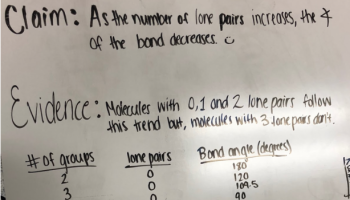
Last year, I taught Valence Shell Electron Pair Repulsion (VSEPR) theory and then had the students complete the pHET simulation called Molecule Shapes.