Chemical Mystery #16: A Red, White, and Blue Chemistry Trick for You!
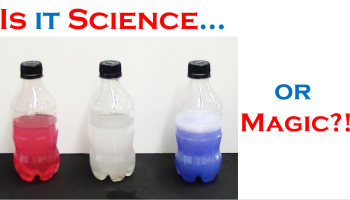
Another school year has come and gone, and summertime is upon us! Soon we’ll all be enjoying cookouts, summer conferences (ChemEd 2019, anyone?), swimming at the beach, and fireworks on the Fourth of July.
Speaking of the Fourth, I thought I’d share a color-changing “Chemical Mystery” that displays a summertime/Fourth of July theme. The chemistry involved is relatively simple, but how the trick is carried out allows for a wide variety of interesting possibilities. Watch the demonstration in Video 1 below. I’ll share the solution with you after a few days. Happy summer, and I hope to see you at ChemEd in Naperville!
Video 1: Tommy Technetium YouTube Channel, Published 6/7/19 (accessed 6/7/19)
Check out the Solution to Chemical Mystery #16!

Tom Kuntzleman
I have taught science at all levels from Kindergarten through upper division undergraduate. Member of ACS, AACT.
Comments
5The explanation my students would come up with first would be the simplest: food-coloring hidden in the caps. A tiny droplet, allowed to dry, would leave an easily-hidden, small black deposit that would match the color of the caps. The dye would dissolve slowly, producing the gradual color change observed.
It doesn't match your keyword list though. Given the pH/indicator hint, I think one bottle has CO2 gas in it, one air and one ammonia. Shaking them dissolves the gasses, lowers the pH in the CO2 bottle and raises it in the NH3 bottle.
NH3 + H2O <==> NH4+ + OH- and CO2 +H2O <==> HCO3- + H+
Congo Red! Red when basic, blue when acidic and colorless(?) between pH 3.1 and 4.9
Do the red one first. The ammonia is less dense than air so the open lid is problematic. Carbon dioxide will stay in the bottle happily. Unscrew the caps from right to left, fill, then close them from left to right. It would be nice to have a student randomize the caps but can't risk them smelling the ammonia.
In reply to The explanation my students by Flint Smith
Hi Flint - great guesses - and great ideas, I might add. I think many combinations of chemical tricks are possible with this bottle/lid set up. I hadn't thought of having gases present in the bottles, but that's a great idea. You can see how I accomplished this particular trick here. If you end up trying different combinations of solutions, substances in caps, and gases in bottles to achieve different effects, I'd love to hear what kinds of effects you can achieve.
Share Your Thoughts