Picks

ChemEd X contributors and staff members are continually coming across items of interest that they feel others may wish to know about. Picks include, but need not be limited to, books, magazines, journals, articles, apps—most anything that has a link to it can qualify.

Many Picks can be purchased from Amazon. Using the Amazon links on those pages help to support ChemEd X.

pick

Gwyneth Paltrow with the marks caused by "cupping"
// Thursday, July 7, 2016 Hal Harris
While I was teaching Introductory Chemistry years ago, the World News reported that the pretty actress Gwyneth Paltrow had shown up at a New York film premiere with odd circular hickeys on her shoulders and back.  It turned out that these were due to her use of an acupuncture technique known as “cupping” in which glass jars are warmed (with a candle, I
argument driven inquiry
// Wednesday, May 4, 2016 Chad Bridle
I have been on a mission lately to make scientists out of my students. I am long past my fears that they are not capable of discovering the world for themselves or that they won’t learn the content if we spend too much time on science practices. What I have to work on now is orchestrating the experience.
PBS
// Sunday, April 17, 2016 E Posthuma
Recently, I was contacted on twitter by a concerned teacher who was using Chemistry Modeling Instruction for the first time. He was looking for supplemental materials to help his students understand why two atoms would form a covalent bond.
Smithsonian April 2013
// Sunday, March 27, 2016 Hal Harris
Brian Greene is not only one of the foremost theoretical physicists/cosmologists, but he also has a talent for explaining some of the most difficult and abstract concepts in physics to those outside of his field.
// Monday, March 21, 2016 Dan Meyers
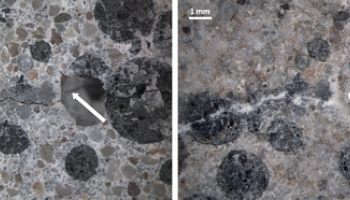
Recently, I came across an article about self-healing concrete on the ACS Central Science open source journal website.
// Wednesday, March 2, 2016 Hal Harris
The variety of stem cell science that has been the subject of most controversy has been the harvesting and use of cells from fetuses.  However, this intriguing account by New Yorker science writer Dana Goodyear relates the story of a revolutionary alternative to embryonic stem cells, stimulus-triggered acquisition of pluripotency, or STAP.