Latest articles, blogs, and events from the chemical education community

text: Chemistry experiments with the Ruben's Tube
// Tuesday, May 26, 2020 Tom Kuntzleman
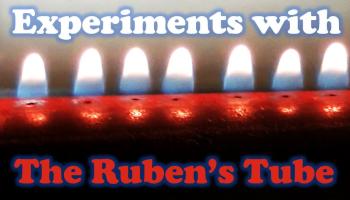
A Flame Tube, also known as a Ruben’s Tube, is a classic physics experiment that provides a spectacular visual demonstration of sound waves.1 To make a Ruben’s Tube, a bunch of tiny holes are drilled in a line about 1 cm apart along one side of a steel pipe (Figure 1).
text: Science & Engineering Practices...at Home
// Tuesday, May 26, 2020 Stephanie O'Brien
During this time of e-Learning, teachers across the globe have shared ideas through various social medal platforms regarding topics such as student feedback, online lesson creation, instructional pedagogy, synchronous versus asynchronous teaching environments, students engagement support strategies, grading policies, online assessment, and best apps and
bear mom cub walking
// Tuesday, May 19, 2020 Scott Donnelly
Welcome and thanks for reading! A year in the life of a bear is more or less equally divided into two parts- half the year it is eating (and eating, and eating) and the other half it is not eating because it is hibernating.
mt st helens
// Sunday, May 17, 2020 Dean Campbell
This year marks the 40th anniversary of the May 18, 1980 eruption of Mt. St. Helens. This eruption and associated landslide, one of the more significant in U.S. history, killed 57 people, removed 2.5km3 of the mountain (enough to fill almost a million Olympic swimming pools), and decreased its height by nearly 400m.
green Pringles can
// Monday, May 4, 2020 Scott Balicki
In Chemistry, students learn about combustion reactions and their applications, such as gasoline engines in cars. Students may be asked to imagine how to maximize the output of such a combustion reaction, and how this maximization point would be determined.
ACCT logo student inside triangle of text: Chemical Thinking Assessment
// Saturday, May 2, 2020 ACCT Admin
If you are an experienced (3+ years) middle school or high school teacher of chemistry in the US in the Central or Eastern time zone, we invite you to apply to participate in the ACCT professional development program to examine how formative assessment can foster students’ chemical thinking. Due to the changes in schooling caused by the COVID-19 pandemic, the ACCT project is changing its plan for professional development for 2020-2021 school year.
Bubble Busting Water Chemistry
// Wednesday, April 29, 2020 Tom Kuntzleman
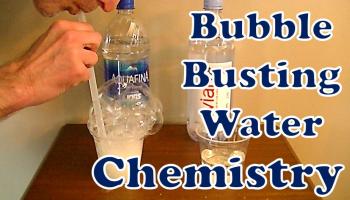
In Chemical Mystery #17, shavings of Dial soap are added to samples of Aquafina and Evian drinking water. Upon blowing into each mixture with a straw, only the Aquafina water produced stable bubbles. Why is this the case?
text: Bubble Bursting Water Chemistry
// Friday, April 24, 2020 Tom Kuntzleman
With most of us stuck at home to combat the recent outbreak of COVID-19, I thought it might be a particularly good time to do some simple chemistry experiments that use only items found around the home (well, more like purchased at my local grocery store).
Johnstone's triangle with images and text at each point
// Tuesday, April 21, 2020 Ben Meacham
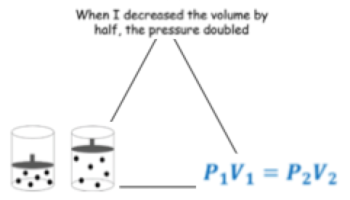
Recently, I asked my students to draw a particle-based model that accounts for the observed increase in pressure when a syringe full of gas is compressed. As they began, one student said, “why do you always make us draw particle diagrams?”
student in orange shirt looking at laptop screen
// Sunday, April 19, 2020 Stephanie O'Brien
While POGIL Activities are designed to be completed synchronously in a collaborative team setting with the teacher present as the facilitator, there are ways to utilize the activities in an asynchronous online setting.
13 cent US stamp, glassware, text: CHEMISTRY
// Thursday, April 16, 2020 mamorgan@me.com
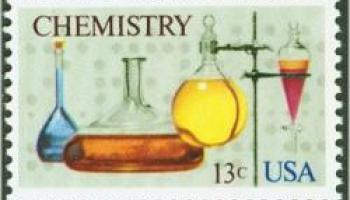
Stamp of the Week (maybe month, year or decade depends on how busy I get)