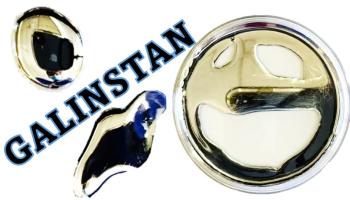
I have always wanted to try the mercury beating heart experiment, in which a drop of liquid mercury is made to throb like a beating heart.1 However, I have never conducted this experiment due to the issues associated with mercury toxicity.
Have you ever been intimidated by (male) students yelling at you? I am female. Many years ago, when I was a younger, less experienced professor, I would return tests and answer questions immediately.
Nuclear chemistry is often one of the most fascinating topics we cover in an introductory chemistry course. Finding demos that are interesting, relevant, and manageable is sometimes challenging. As a ceramic artist and chemistry professor, using Fiestaware® to talk about the historical use of radioactive isotopes is my favorite demonstration.
I will cut right to the chase. “Understanding Chemistry through microscale practical work” by Bob Worley, David Paterson and with Sarah Longshaw is a book you should get if you ever want to consider successfully doing microscale chemistry with students.
Solutions are all around us in life and chemistry class! Solution chemistry is a topic that connects to many other topics covered in the high school classroom. On February 10th, 2022, Kristen Vanderveen shared her unit covering solutions in this ChemBasics Talk. You can view a recording of her presentation below and access mater
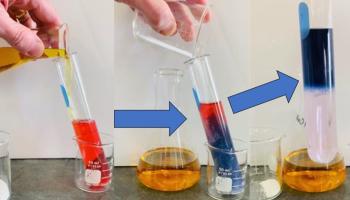
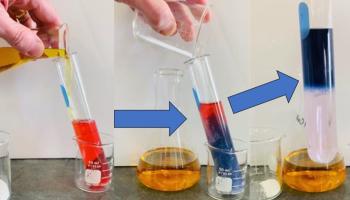
In Chemical Mystery #19,1 a yellow liquid is poured into a test tube, and the liquid turns red. When a white sold is added to the red liquid in the test tube, the liquid turns blue.
Presentation title: The Effect of Multiple Assessment Opportunities on Student Achievement in a Large General Chemistry CourseDate: Friday, February 11, 2022
Start: 11:00 Pacific = noon Mountain (+ Arizona) = 1:00pm Central = 2:00pm Eastern
I was recently playing around in the lab and discovered a new experiment that is very easy to carry out, but also results in a variety of mysterious color changes. You can watch it in the video below.
As chemistry teachers, we often think about how we can make our subject “real world” for our students. We want them to be able to connect concepts to their lives, as we know that this increases not only their interest in the course, but also engages their prior knowledge and increases their long term retention of the concepts.
The importance and difficulty of concepts of the electrolyte came home to me while I was helping a student. She was having difficulty with the idea of an electrolyte. Specifically, she 1) misapplied the maxim "Like dissolves like," and 2) could not distinguish between the terms "dissolve" and "dissociate". In my knowledgeable na