Walking in the Footsteps of Scientists Who Came Before Us
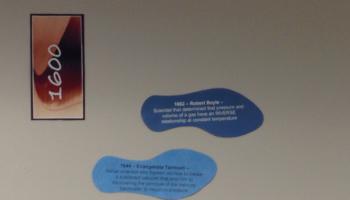
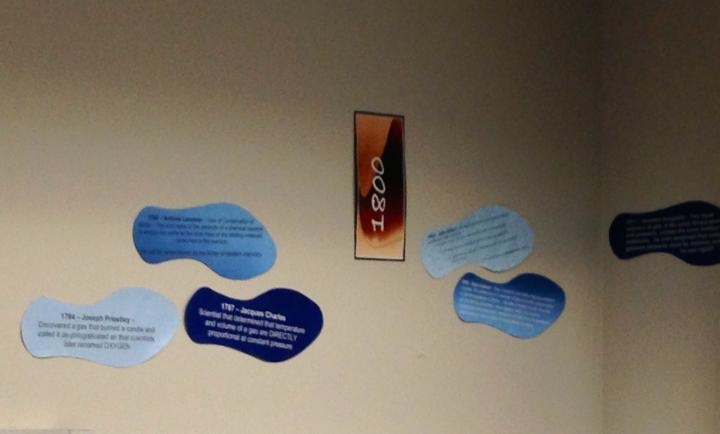
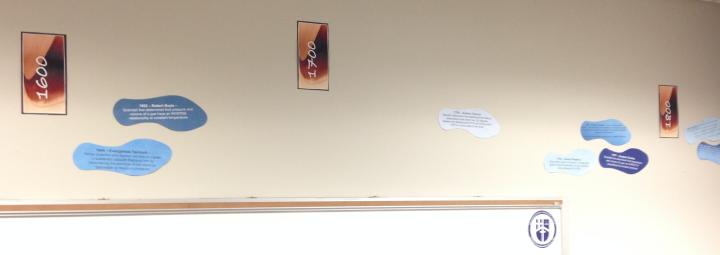
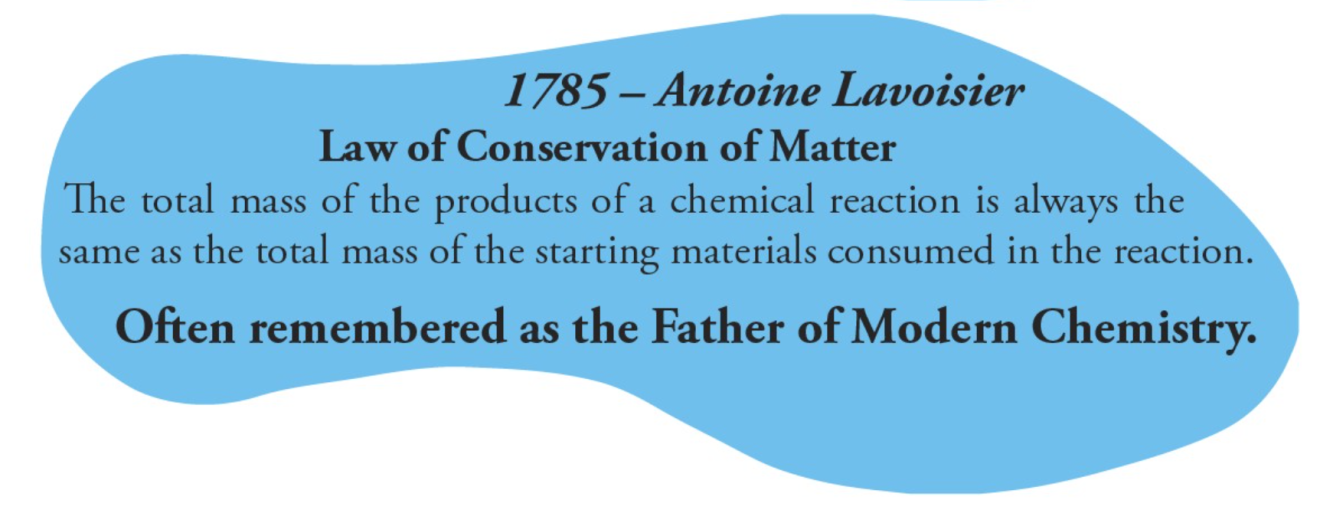
I know that many of you teach chemistry in a traditional order of topics -- atoms, bonding, reactions, stoichiometry, etc. However, I walked away from that order six years ago and started teaching in a chronological order when I began using Modeling Instruction in my classroom. During the second year of "walking in the footprints of the scientists that came before us", I wanted my students to see where they were walking and a colleague* and I came up with the idea of making footprints for each of those scientists and posting them on a timeline.
We started this timeline with the four elements -- Earth, Water, Fire, Wind (air). Then we moved to Democritus (400 BC) who gave us the word "atom" and of course, there are no other chemistry milestones in our history until the 1600's.
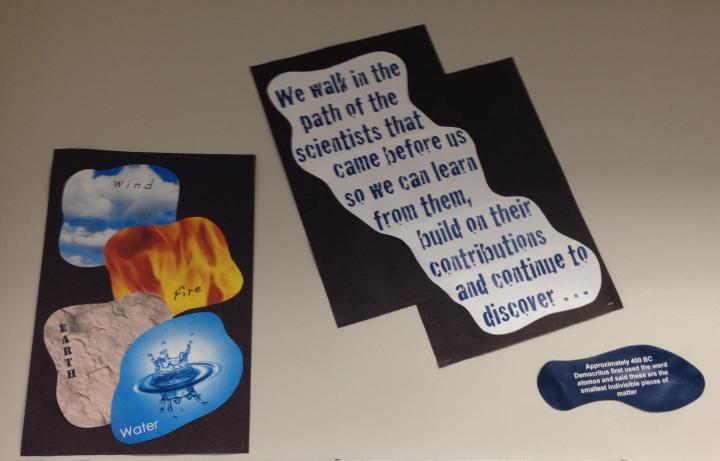
Attached to this post, you will find the elements (earth, water, fire & wind) the quote I use with the elements, the timeline date markers, and the footprints. These are all in WORD documents and the color of the footprint can easily be changed to "fit" the teachers classroom, as can the date marker, etc. You may put the timeline up all at one time or add to it as the year progresses. Either way, I hope that it will be a useful tool for your curriculum.
NOTE: As of 3/30/17 - The posters have been compiled into 8.5" x 11" and tabloid size sets that you may download. You will still find two Word documents that you may edit if you wish to add more "steps" to your timeline.
*I would like to acknowledge my colleage, Bill Thornburgh, that helped me develop this idea. He is working on his PhD in Science Education at University of Louisville.
Laura Slocum was honored as the 2017 James Bryant Conant Awardee. Read Tracing the Steps to the Conant Award (accessed 9/2017).
NOTE: As of 3/30/17 - The original set of posters have been compiled into 8.5" x 11" and tabloid size sets that you may download. You will still find two Word documents that you may edit if you wish to add more "steps" to your timeline. Also, the author published 12 additional footsteps on 4/24/17 to add to the timeline. You will find them as one pdf as supporting information.
Collection(s)
Laura Slocum
Moorestown Friends School
ChemEd X Subscriber, Subscriber, Reviewer
Comments
10Thank you! I know exactly where this is going to in my classroom and it fits perfectly with "The Model so Far"!
Will Use!
Thank you, Laura! This is amazing. I plan on using these and expanding on it as well! Names that come to mind immediately (as I wrap up Unit 2) are Charles, Gay-Lussac, Davy, Farenheit....
Glad these are benefiting you!!!
I have a footprint for Charles and GayLussac -- have included Torricelli and Kelvin, too. Did NOT think about Davy and would not use Fahrenheit, since I am really trying to get my students to "think metric" and not use the English systems of measurement in our class.
I really do like this idea lots and at Parent Science Night last night a number of parents liked it, too!!!
What a cool idea!
Thanks Laura for putting this together. What a cool idea. I could post these outside my classroom as footprints leading in where even more can be discovered! Maybe students could even add as we discover more within the timeline!
My scientist list
I use the scientists to guide through notes on the theory portion of the course (2nd quarter for me). It holds students interest in a bit different way because they can connect it to people and recognize some of the partnerships and competitors that exist in science. The nuclear story is especially cool to me, you'll have to do your own research though. (Some repeated)
Atomic theory: Democritus, Robert Boyle, Antoine Lavoisier, Joseph Proust, John Dalton, Amedeo Avogadro, Stanislao Cannizzaro, J.J. Thomson, Robert Millikan, Ernest Rutherford
Electron Theory: (J.J. Thomson), (Ernest Rutherford), Maxwell Planck, Albert Einstein, Niels Bohr, Werner Heisenberg, Wolfgang Pauli, Louis, deBroglie, Erwin Schrodinger, Friedrich Hund
Periodic Table: Hennig Brand, Johann Dobereiner, A.E. Beguyer de Chancourtois, John Newlands, Dmitri Mendeleev, Lord Rayleigh, Earnest Rutherford, Henry Mosely, (Niels Bohr), Glenn Seaborg
Nuclear Age: Wilhelm Roentgen, Henri Becquerel, Marie Curie, (Ernest Rutherford), Frederick Soddy, James Chadwick, Irene Joliet-Curie, Lise Meitner, Glenn Seaborg, Willard Libby
There are certainly far more I could include, and definitely we discuss some more than others, but paints a fuller picture this way. I like to remind students that our knowledge comes from actual science and discoveries tend to build off the research of others - the reason we communicate our research findings. Also, I like to stress that sometimes we revise our theories because of improvements in technology.
In reply to My scientist list by John Yohe
pattern to add your own
Hi John! Laura Slocum added some footsteps to her timeline this week, so we are highlighting this post again.
I like your list as well. Anyone can add to their own timeline by editing the Word documents that are listed along with the full sets that are PDFs.
Thanks for your interest.
Diverse representation?
I like this idea, thanks for sharing!
I wonder if it would be possible to recognize the contributions of women and people of color in these footsteps? I think there are many reasons why the canon of scientific heroes consists mostly of white men, but maybe we can provide a counternarrative that inspires all our students?
Share Your Thoughts