HS-PS1-2 Chemical Reactions

Students who demonstrate understanding can construct and revise an explanation for the outcome of a simple chemical reaction based on the outermost electron states of atoms, trends in the periodic table, and knowledge of the patterns of chemical properties.

*More information about all DCI for HS-PS1 can be found at https://www.nextgenscience.org/dci-arrangement/hs-ps1-matter-and-its-interactions and further resources at https://www.nextgenscience.org.

Summary

Students who demonstrate understanding can construct and revise an explanation for the outcome of a simple chemical reaction based on the outermost electron states of atoms, trends in the periodic table, and knowledge of the patterns of chemical properties.

Clarification

Examples of chemical reactions could include the reaction of sodium and chlorine, of carbon and oxygen, or of carbon and hydrogen.

Assessment Boundary

Assessment is limited to chemical reactions involving main group elements and combustion reactions.
Synonyms
HSPS1-2
PS1-2
Chemical Reactions
// Sunday, November 16, 2025 Tom Kuntzleman
The conversion of adenosine triphosphate (ATP) into adenosine diphosphate (ADP) is an extremely important energy source for living organisms. Under common physiological conditions, it can be expressed as:
Assassin's Bottle title card
// Tuesday, September 16, 2025 Tom Kuntzleman
The disappearing rainbow1 is a wonderful chemistry demonstration previously featured here on ChemEdX.2-4 In this experiment, a colorless solution of NaOH is poured into a row of flasks, each containing a different acid–base indicator.
The WEIRDEST Chemical Reaction I've Ever Seen! preview image with octopus icon
// Saturday, September 7, 2024 Tom Kuntzleman
Galinstan is the tradename for a liquid metal alloy that is comprised of three elements: gallium (68.5%), indium (21.5%), and tin (10%).1 It behaves a lot like mercury but has significantly lower toxicity. Because of this, Galinstan is used as a replacement for mercury in a variety of applications.
"Quick Lab on Mass vs Moles" preview image includes 3 test tubes in rack with title
// Tuesday, March 5, 2024 Nora Walsh
This year, I tried something different with my course progression - instead of doing chemical quantities first and teaching students to convert from grams to mole and then move into stoichiometry, I began with mole to mole stoichiometry and BCA tables.
Drinking Dinosaur Pee?! title on preview image with dinosaur head in a flask.
// Monday, November 27, 2023 Tom Kuntzleman
Many have asserted that the water we drink is exactly the same water that has been eliminated from the bodies of humans and animals from the past. The argument goes that water excreted from our bodies by exhalation or urine ultimately ends up back in the water cycle.
// Monday, August 21, 2023 Tom Kuntzleman
The floating soap bubble1 is an experiment that is very easy to set up and carry out (Video 1).
// Thursday, June 1, 2023 Tom Kuntzleman
An experiment that has always fascinated me is observing what happens when CO2 is bubbled into limewater (which is a saturated solution of calcium hydroxide).1-2 This experiment can be carried out by blowing bubbles of exhaled breath (which contains roughly 4% CO2)3 through a straw into limewater.
// Tuesday, February 28, 2023 Tom Kuntzleman
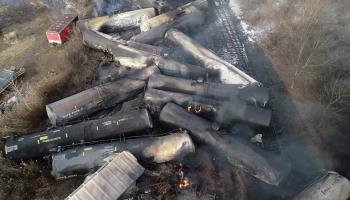
On February 3, 2023, a train derailed in the town of East Palestine, Ohio.1-2 Five of the train cars were carrying vinyl chloride (Figure 1), a compound that is mostly used to make PVC.