continuing education

SAFER SCI: Be Protected!

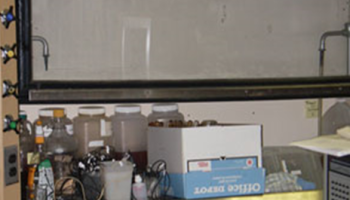
As we all know, research and general educational practice clearly indicates that students learn science best by doing it – not just reading about it. Hands-on, process and inquiry based science is the key to understanding science. Unfortunately, this is a double edged sword for science teachers in that doing science has its potential hazards and resulting risks. Science laboratories, classrooms and field work sites can be unsafe places to teach and learn. If a student gets hurt while doing an activity in the lab, in the field or even at home if it was a teacher’s assignment, there is potential shared liability for both the teacher and the school. 

Selling and Implementing Roles and Teamwork in the Classroom

I saw the process of students thinking like scientists but what I struggled with, and I imagine many others do as well, is how students work together in groups. Yes...I know it is important but is this a big battle that I want to fight? I was fortunate to meet several people who have developed some wonderful “tricks of the trade” to help students work as “teams”.


Creating a Classroom Culture - Call for Contributions

This Call for Contributions has closed. As many school districts are moving toward incorporating student-centered curriculum and pedagogy, many teachers have found that it can be difficult to initiate a classroom culture that encourages students to embrace the change which calls for them to engage in discussions and take more responsibility for their own learning. Chemical Education Xchange (ChemEd X) is interested in learning about how teachers are creating a culture of student-centered learning in their classrooms. For this reason, we are initiating our content specific CALL FOR CONTRIBUTIONS centered on the concept of “Creating a Classroom Culture”.

You Are Invited: Chemistry Instruction for the Next Generation

ChemEd X and the Journal of Chemical Education (JCE) are collaborating to offer a virtual conference like most have never seen before. It is not a webinar. You do not have to schedule specific hours to view a live presentation. I think of it as similar to a virtual book/journal club with the added benefit of having the author leading it. In this case, authors were selected from among those who have published recent articles, activities and research in JCE on the topic of student-centered instruction in chemistry. The theme of this inaugural conference is Chemistry Instruction for the Next Generation.

Colligative Properties in Real Life

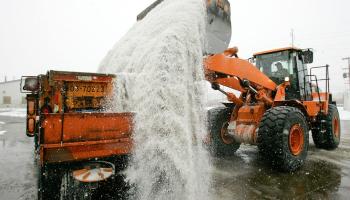
This year in the midwest United States, winter has been a fickle friend. I haven’t seen the same amount of snow or ice as in recent years, but I still made sure I was prepared for it at our home. I went to my local big box hardware store in December and contemplated buying rock salt (NaCl), and NaCl/calcium chloride mixture, or just calcium chloride. Growing up my dad had switched entirely to calcium chloride because it was less damaging to the brick pavers leading to our porch and backyard. In fact, calcium chloride is generally much safer toward plants and soil than NaCl. Even though calcium chloride is much more expensive than rock salt (it was about twice the cost for 10 pounds more), that what’s I chose. Why?

Following BCCE 2014 From Afar

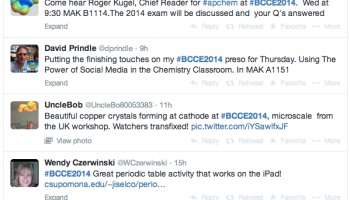
If you are like me and unable to attend BCCE 2014, there is still a way to be part of the action. Twitter! Even if you don't have a Twitter account, you can follow tweets from participants that are there "live tweeting" the action.

AACT at BCCE

Physics teachers have AAPT, biology teachers have NABT, and starting this fall, chemistry teachers will have AACT. We are happy to announce that the American Association of Chemistry Teachers (AACT) will be accepting charter members starting on Aug. 4 at BCCE in Grand Rapids, Mich. But if you aren’t attending BCCE, you can join AACT by visiting teachchemistry.org on Aug. 4, and you’ll still have the status of charter member.