Activities

ChemEd X activities are student-centered resources intended to aid learning chemistry topics.

ChemEd X encourages engaging activities where students (with guidance from the teacher) pose questions, analyze data, and make observations to offer a plausible explanation supported by data and consistent with physical observations.

activity
ice cream ingredients
// Monday, April 28, 2014 Deanna Cullen
A quick google search will allow you to find many laboratory activities for making ice cream in chemistry class. Some of the links provide questions to incorporate into the activity. I have used several over the years and will share my modified version here.
// Thursday, March 20, 2014 mamorgan@me.com
The purpose of this unit is to acquaint you, the student, with some research techniques and to involve you in the discovery learning process. You will be given a topic to work on and some guidelines for what you should accomplish. You will work in groups of three and share your results with the other members of your group.
preview complex ions lab
// Wednesday, March 19, 2014 mamorgan@me.com
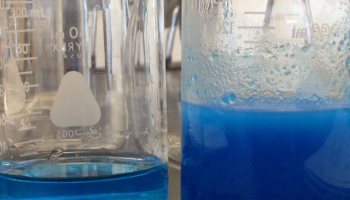
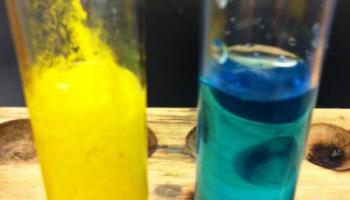
This laboratory exercise accompanies the article "A guided group inquiry lesson on coordination compounds and complex ions". The laboratory serves as part of an extended exercise on the chemistry topic of coordination compounds and complex ions.
test tubes with sample reactions
// Wednesday, January 15, 2014 Deanna Cullen
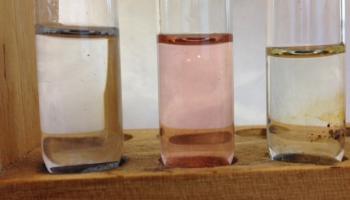
I expect that most high school chemistry teachers assign some type of laboratory related to types of chemical reactions including synthesis, decomposition, single replacement and double replacement reactions. I have used several published versions, but I am sharing my modifications. 
Worksheet for Orbital Viewer Program
// Thursday, December 5, 2013 Tom Kuntzleman
Orbital Viewer, written by David Manthey, is a fantastic program for displaying electronic orbitals. You can read more about the program here. I have my students use Orbital Viewer when learning about quantum numbers and their associated rules, electronic orbitals, and other quantum concept
orbital viewer image of d orbital
// Tuesday, December 3, 2013 Tom Kuntzleman
Orbital Viewer, written by David Manthey, is a fantastic program for displaying electronic orbitals. The program has many different orbital-viewing options that are somewhat cumbersome to learn how to use. However, it is easy enough to learn how to use the program at a basic level. It i
preview image of solutions pHet simulation
// Monday, September 16, 2013 Trish Loeblein
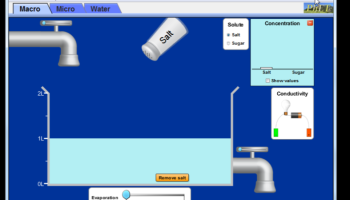
This is a series of experiments, PhET Interactive Simulation activities, and clicker questions to relate macroscopic and molecular representations of homogenenous solutions. Graphing skills are also used. Materials Access to PhET Inteactive Simulations -
// Sunday, April 7, 2013 Deanna Cullen
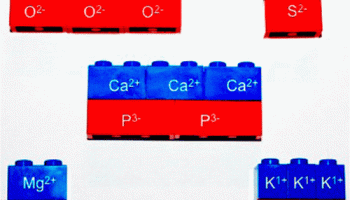
This activity is used as a reinforcement activity following my use of JCE Classroom Activity #113: An Interlocking Building Block Activity in Writing Formulas of Ionic Compounds. It could be used as a stand alone activity to support writing ionic formulas and names.
model of particle level of electrochemical cell
// Wednesday, October 10, 2012 Deanna Cullen
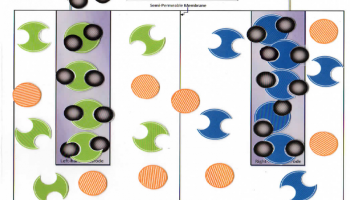
I was lucky enough to be part of the second cohort of Target Inquiry teachers at Grand Valley State University. As part of the program, we each wrote, tested and revised two chemistry laboratories for use at the high school level. One of mine is the lab I am sharing here.
Trendsetter Lab
// Wednesday, October 10, 2012 Deanna Cullen
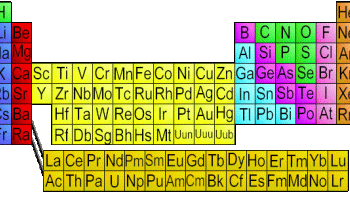
Students will proceed through a pre-lab engagement activity, organize element cards based on similarities & trends, discuss trends with the class and then produce a periodic table that includes the trends discussed within the lab. The teacher will check for student understanding at specific points as groups work together.