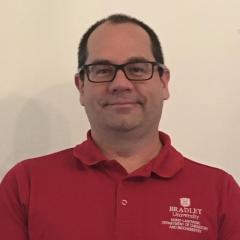
Dean Campbell
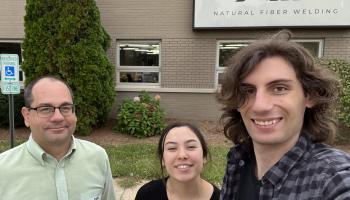
Prior to coming to Bradley University, Dr. Dean Campbell graduated from the University of Wisconsin – Green Bay with a B.S. in chemistry, where he worked with Drs. Jack Norman and Nancy Sell. He spent a summer revising technical training documents at the Kewaunee Nuclear Power Plant in Kewaunee and worked in the ink and adhesives quality control lab at Moore Response Marketing Services. He then earned his M.S. and Ph.D. in chemistry at Northwestern University in Evanston, IL, working for Dr. Chad Mirkin, and enjoyed postdoctoral research at the University of Wisconsin – Madison, working for Dr. Art Ellis.
Dr. Campbell joined the Department of Chemistry and Biochemistry at Bradley University in 1998. His primary teaching areas include general, inorganic, materials, and environmental chemistry. He believes that everybody can benefit from learning chemistry.
Dr. Campbell has done sabbatical research projects with Dr. Younan Xia at the University of Washington, Seattle, WA (2004-05), and Dr. Keith Stevenson at the University of Texas – Austin (2011-12). He served as the faculty advisor of the Chemistry Club (which has been honored by the National American Chemical Society for many years). He still serves as the director of the Chemistry Club Demo Crew, which he founded the in 2007 to involve students in science outreach. We have reached out to 36,000 participants in 370 events so far. In 2014, he was awarded Illinois Heartland Local Section of the American Chemical Society 2013 Chemist of the Year and Illinois Heartland Local Section of the American Chemical Society 2014 Outreach Volunteer of the Year. He has been the co-author on about 50 peer reviewed publications and 75 research presentations at off-campus venues.
Dr. Campbell’s research interests include two intertwined areas: materials chemistry and chemistry education. In materials chemistry, he is involved in the synthesis and characterization of a variety of microscale and nanoscale structures with at least one dimension less than 1000 nanometers in size. These small structures can have characteristics (e.g. optical and catalytic properties) that distinguish them from both individual molecules and extended solid structures. Nanostructures such as colloidal gold and palladium particles are synthesized by a variety of wet chemical methods, often within a polymeric support to improve their ease of use and recyclability, and then their structure and chemical reactivity are characterized by techniques such as ultraviolet/visible absorption spectroscopy, nuclear magnetic resonance spectroscopy, and electron microscopy.
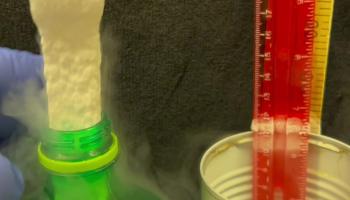
Areas of work in chemistry education involve the development of new demonstrations and activities for use in a classroom or educational laboratory setting. Where possible, the demonstrations are designed to be as simple and cost-effective as possible. Projects have often included: modeling chemical structures and properties with LEGO brick-based and paper-based structures, easily observable demonstrations of nanoscale materials and properties, and demonstrations of various aspects of environmental chemistry.
Dr. Campbell spends a bit of his free time with family activities. His hobbies include rock and fossil collecting and hiking and he assists in religious education at St. Anthony's Church in Bartonville, IL.