Picks

ChemEd X contributors and staff members are continually coming across items of interest that they feel others may wish to know about. Picks include, but need not be limited to, books, magazines, journals, articles, apps—most anything that has a link to it can qualify.

Many Picks can be purchased from Amazon. Using the Amazon links on those pages help to support ChemEd X.

pick

// Monday, September 1, 1997 Hal Harris
Heat a ball of lime in a hydrogen-oxygen flame, and what do you get? Limelight! This very intense light source was used for lighting plays (hence the modern usage of the word), but it also was the source for the record distance, for a time, over which man-made light was observed.
// Friday, August 1, 1997 Hal Harris
It's not too late to do some recreational reading this summer. "Catalyst" is an enjoyable, light read, especially for chemists. How often do you find a novel that includes catalysis, NMR, mass spectrometry, TLC, some scientific misconduct, and a little sex?
// Tuesday, July 1, 1997 Hal Harris
Most of the chemistry professors and teachers with whom I am acquainted are fairly pleased with the national trend toward putting more computers in school, college, and university classrooms.
// Sunday, June 1, 1997 Hal Harris
I like almost everything about this book, except the title. I don't believe that teachers of science should be "explaining" science in their classrooms and, fortunately, the authors of "Explaining Science" don't, either.
// Thursday, May 1, 1997 Hal Harris
Bernd Heinrich is one of my favorite writers about nature, and especially insects. I discovered his "Bumblebee Economics" (Harvard University Press paperback) a number of years ago, and used it in a course for non-science majors that I taught in our Honors College.
// Wednesday, April 2, 1997 Hal Harris
The "river" to which Dawkins refers in the title of this little (172 page) book is the river of digital genetic information that connects us to our human ancestors and to the rest of life on our planet. I find this metaphor to be an extremely provocative one, and I suspect that it would appeal to many of our computer-addicted students.
// Tuesday, April 1, 1997 Hal Harris
If you have students looking for an interesting science project, the May Scientific American has a nice one. A sun photometer can be used to determine the amount of haze in the atmosphere, and this article describes one that can be built in a couple of hours for less than $20 (although you also need to have a voltmeter).
// Sunday, February 2, 1997 Hal Harris
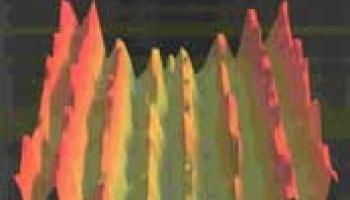
The very first of "Hal's Picks", back in 1995, was the announcement of the first experimental observation of a Bose-Einstein condensate. This can be considered as a new phase of matter, in which atoms in a cold cluster lose their separate identities, because their deBroglie wavelengths exceed the dimension of the group in which they find themselves.