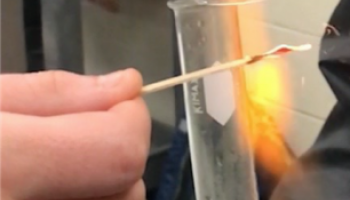
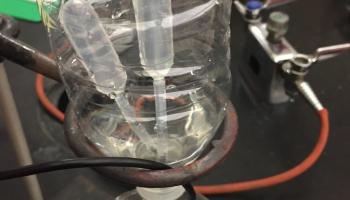
To grasp the concept of oxidation and reduction reactions, I have my high school students write half reactions to show the loss and gain of electrons by the substances being oxidized and reduced. To help with this concept, I developed a quick lab activity involving the reaction between magnesium metal and dilute hydrochloric acid, which in turn led to
It’s the end of one semester and the beginning of another. Final exam week. For the first time in my teaching career, I had my grades caught up and posted prior to the beginning of final exams. This gave me time to reflect and plan ahead.
Here are some highlights of the fall semester:
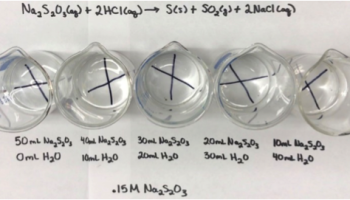
Whether you are introducing collision theory or something more demanding like reaction order, the reaction between sodium thiosulfate—Na2S2O3 and hydrochloric acid can provide a consistent, accurate, and engaging opportunity for investigating these topics.
Free Webinar for all AMTA members!
The NGSS calls for the use of the engineering design process in science classrooms K12. Let’s discuss what this means for the modeling classroom. Bring your ideas about how and when to integrate the engineering design process and engineering projects into your classroom.
This session will be hosted by Kathy Malone and Anita Schuchardt.
This webinar will discuss how to approach teaching stoichiometry problems using a table set-up (commonly referred to as Before, Change, After tables) to make the process visually appealing and more intuitive for students. The process emphasizes proportional reasoning and explicitly connects the calculations to the particulate nature of matter.
Connections to equilibrium calculations will also be discussed to show how this method can easily be integrated in to your curriculum and benefit your students in more than one area.
The RET Site is a unique professional development opportunity for STEM teachers from Indiana and Alabama over six weeks in the summer of 2017. Teachers will conduct research and participate in professional development. All participants will be provided funding and support to implement new, standards-based curricula into their science courses at their respective high schools. See the RET announcement.
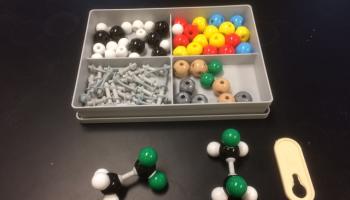
I have been looking at model building labs in some of my previous posts and would like to continue with that theme. In my last post I talked about an activity where students try to recognize functional groups by examining previously built molecules.
Free Webinar for all AMTA members!
The NGSS calls for the use of the engineering design process in science classrooms K-12. Let’s discuss what this means for the modeling classroom. Bring your ideas about how and when to integrate the engineering design process and engineering projects into your classroom.
This session will be hosted by Kathy Malone and Anita Schuchardt.
Register now to attend the AACT webinar on January 25 at 7:00 EST. This webinar will introduce demonstrations you can use when they first learn the material, or as they prepare for the AP test. You'll be provided with demonstration questions that can be scaled up or down depending on the level of chemistry that you teach.
Hosted by Jamie Flint.