What: 2YC3 (Two-Year College Chemistry Consortium) summer conference in conjunction with the 50th ACS Central Regional Meeting (CERM)
Where: Midland, MI
When: June 7-8, 2019
Registration: https://acscerm2019.org/
Registration Cost: $49 (by April 30); $99 (after April 30)
"In honor of the International Year of the Periodic Table this series of articles details the Element of the Month project developed by Stephen W. Wright (SWW), Associate Research Fellow at Pfizer Inc., and Marsha R. Folger (MRF), chemistry teacher (now retired) at Lyme – Old Lyme High School in Connecticut.
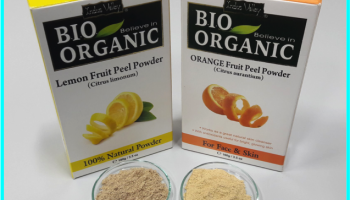
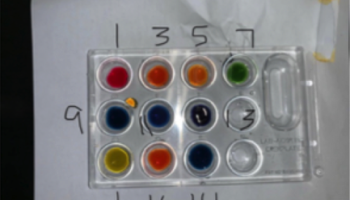
In this article, I would like to introduce a procedure which involves the removal of copper from a solution through a process known as biosorption. I covered something similar in a previous ChemEd X blog1, but in this article I will be running the experiment by using a different analytical method.
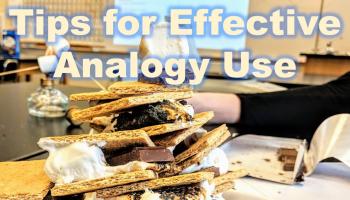
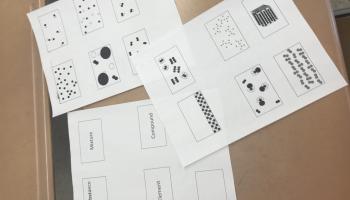
Chemistry is difficult to learn. Walk into any chemistry classroom, and you’ll be soon confronted with many abstract concepts. Abstract ideas have no physical form, and as a result, they are difficult to understand. Topics like the mole, quantum numbers, and the atom are tricky to comprehend unless they are related to something more concrete.
How many of you could recite, word for word, a definition you learned in school? When you first memorized the definition, you could state “inertia is a property of matter”, or “density is mass over volume”. However, you struggled to apply it to a new situation and maybe you were unsure of how to construct a model of what it meant.
In case you missed it, this post is the second installment in a series called “SBG Hacks”. The purpose of this series is to share with you some of the small things I do in my classroom to make my standards-based grading system run smoothly.
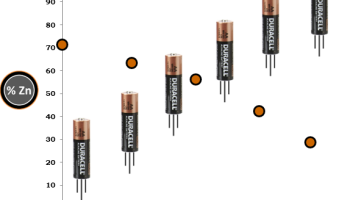
Did you know there is a simple test you can do to see if an alkaline battery is fresh or dead?1,2 All you need to do is bounce the bottom of a battery onto a hard, flat surface. If the battery is fresh it won’t bounce very well. If the battery is dead, it will bounce very high. Check it out in the video.3