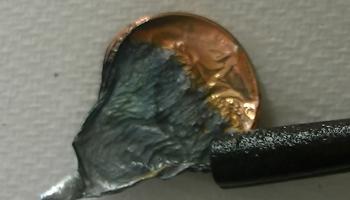
I am fascinated by the chemistry of pennies. Dissolving a penny in nitric acid is one of the most visually stimulating chemistry reactions I have ever seen.
The start of a new school year is fast approaching and as we begin to plan for our first days back with students I thought I’d share one of my favorite first day activities.
Editor Notes:
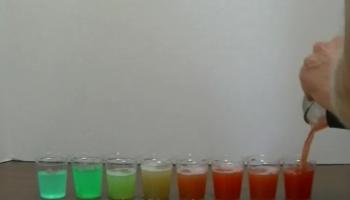
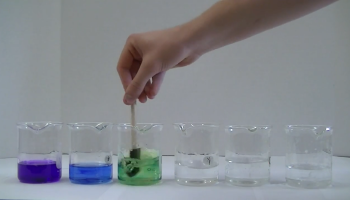
One day during class I presented the disappearing rainbow demonstration and explained the chemistry behind it. After doing so, I had a student ask me if a particular bartending trick called “rainbow shots” was done in a manner similar to the way the disappearing rainbow demonstration is performed.
The American Chemical Society will hold its 248th National Meeting in San Francisco, CA on August 10-14, 2014. More than 15000 scientists are expected to attend and over 7000 presentations are slated, comprising symposia that highlight a broad range of scientific advancement. The theme of the Fall meeting is Chemistry & Global Stewardship.
Here is something to ponder as you think about your lab experiences this year: I have been using an excellent inquiry lab for the past few years. I think it does a fabulous job guiding the students through the amazing (yet often dull to students) world of specific heat equations and learning about calorimetry. However, this semester, I returned to
I was looking for a new demonstration to initiate a discussion about polarity and related properties to use as part of an exam review. I found a video at ChemEd X (this is part of a ChemEd X subscription). It is entitled “Floating Squares – Hexane and Water” (see note below). I have placed both solutions together before, but I had not added the squares. The demonstration fulfilled my needs. I could have used the original video and muted it if I had not had hexane to demonstrate with.
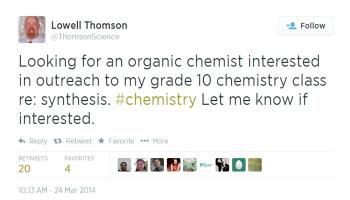
I've mentioned previously that my current grade 10 class is reading "The Case of the Frozen Addicts" together. As my students starting writing their blogs to respond to the reading, I saw quite a few questions that I couldn't answer. But I didn't want to leave the questions there with no response, so I went to Twitter to find scientists to join my class as a guest speaker.
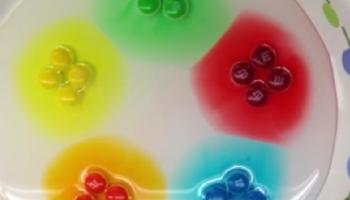
Last year I wrote a blog about a very simple experiment can be done using water, a plate and M&M’s candies. The experiment can be seen in the video below:
Congratulations to Andres Tretiakov who solved Chemical Riddle #2. In this particular riddle, we presented a twist on the famous “Disappearing Rainbow” demonstration. You can purchase a
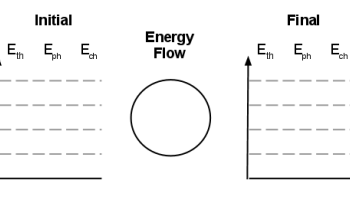
In a previous blog post I described some problems I encountered when beginning my instruction on energy this year. From the misconceptions fostered by the biology textbooks using the phrase “high-energy phosphate bond” to idea that energy comes in different forms, the Modeling community recognizes the challenges of teaching the energy concept and has developed a way of talking about energy designed to help students construct a consistent and cohesive model.
A student of mine, Anthony Shepherd, and I worked together to develop a new chemical riddle. How do you think we performed the experiment in the video below?