The ACS Committee on Chemical Safety has published new Guidelines for Chemical Laboratory Safety in Secondary Schools. This document is organized with the R.A.M.P.
Teachers are accustomed to implementing new learning standards developed by state or national leaders. My state, Georgia, chose not to adopt the newest national standards. State leaders wrote the “Georgia Standards of Excellence” instead. Full implementation of the GSE begins in the 2017-2018 school year.
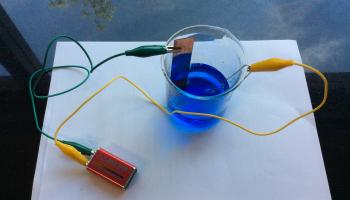
My IB seniors are just wrapping up our unit on electrochemistry and redox. This has always been a challenging topic within the IB curriculum. Admittedly, electrochemistry has not ever been my strong suit either, so this year I aimed to strengthen the unit with two additional demonstrations.
Preface: I am proposing a challenge based on this mystery. If you wish to know more about this challenge, please be sure to read the Challenge section found at the end of this blog post.
AMTA will be hosting a distance learning Chemistry 2 course that will run from January 19th -April 27 (15 weeks), with an open house to prepare with technology on January 12th. It will be led by expert chemistry modeling leaders Larry Dukerich and Brenda Royce. The course develops on an evidence-based approach to the internal structure of the atom, periodicity and covalent bonding, intermolecular forces, equilibrium and acids and bases.
To squash any misconceptions, I would like to say first and foremost I am not a great cook. My husband graciously does most of the cooking in our house. However, as a chemist, I am fascinated by the complex reactions involved in everyday life.
In July of 2016 we learned the names of the four new elements that were confirmed in January; Nihonium (Nh), moscovium (Mc), tennessine (Ts) and oganesson (Og). Although the newest superheavy elements complete the seventh period of the Periodic Table, curiosity has been reignited in our classrooms as students ask, what’s next?
In the state of Michigan where I live, the University of Michigan (UM) and Michigan State University (MSU) are rivals. Green is the definitive color of MSU, whereas blue and gold are the school colors of UM. I went to school at UM, so naturally I am partial to blue and gold.
In the case of scientific exploration in the classroom, the word “misconception” tends to relate to ideas that are inconsistent with scientific evidence. Generally, misconceptions are recognized as a negative aspect of the classroom environment.