Latest articles, blogs, and events from the chemical education community

// Friday, February 21, 2014 Tom Kuntzleman
The nail bottle demonstration1 is one that many of us have conducted in our classes. To perform this demonstration, 2 – 3 mL of ethanol is placed into a plastic bottle that has two nails punctured into opposite sides of the bottle. After stoppering the bottle, a Tesla coil is touched to one of the nails.
// Thursday, February 13, 2014 Tom Kuntzleman
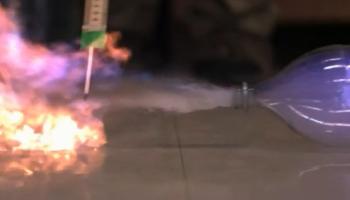
My students and I intend to use a high-speed camera to film a variety of chemistry experiments in slow motion.  The first reaction we have decided to film is the “Whoosh Bottle”.  You can read more about this particular experiment in an article in Journal of Chemical Education h
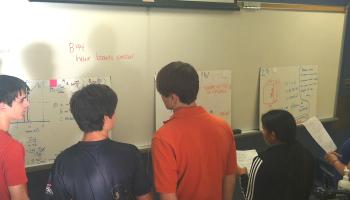
Students participate in a BoardWalk
// Sunday, January 26, 2014 E Posthuma
In my first post I mentioned using the Chemistry Modeling Curriculum (CMC) in my classroom. Although Modeling Instruction (MI) has been around for over 20 years, I discovered it during a workshop in the summer of 2010.
// Monday, January 13, 2014 LowellThomson
By way of introducing myself, I'd like to respond to Deanna Cullen's blog post about social media here on ChemEd X with some ideas of my own. The reason I'm here is that Deann
// Thursday, January 9, 2014 Tom Kuntzleman
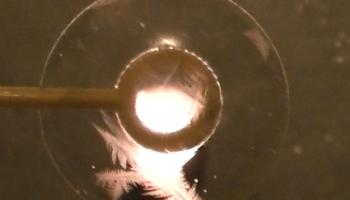
Want to try an easy, yet interesting chemistry experiment this winter? Try this: Blow some bubbles into the outside winter air and catch one of the bubbles with a bubble wand. If it is cold enough outside, the bubble will freeze! 
Preview image - title: "Ice Clouds" image includes cloud of ice in front of house.
// Monday, December 16, 2013 Tom Kuntzleman
I get excited when I see the outside temperature drop below 0°F (-18°C). This is not because I enjoy cold weather. It is because when the outside temperature gets this cold, I can conduct a particular experiment that I think is quite beautiful. The experiment is easy to carry out: boil some water and throw the hot water into the frigid air. Check it out below:
// Wednesday, November 20, 2013 Tom Kuntzleman
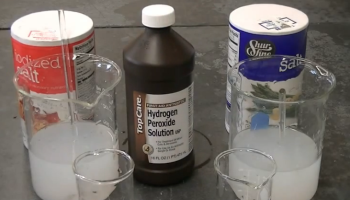
JCE Classroom Activities are a collection of over 100 chemistry experiments and demonstrations that can be carried out using simple materials found around the house or at grocery store and hardware stores. For example, JCE Classroom Activity #92 describes how to test for the presence of iodide in iodized salt using only water, iodized salt, 3% hydrogen peroxide, vinegar and liquid laundry starch.
// Saturday, October 19, 2013 Tom Kuntzleman
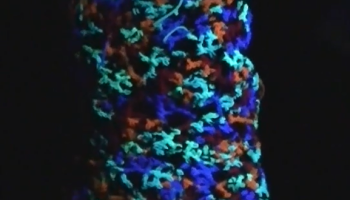
Halloween is a great time of year to do experiments with fluorescence. In the video below, we experiment with some fluorescent yarn.
// Friday, October 18, 2013 Deanna Cullen
The College Board released a new framework for the AP chemistry course that teachers are using this year. The new curriculum emphasizes big ideas, enduring understandings, and science practices.
soap boat
// Wednesday, October 2, 2013 Tom Kuntzleman
Have you ever seen the soap boat experiment? Check out the video below.  
preview image of solutions pHet simulation
// Monday, September 16, 2013 Trish Loeblein
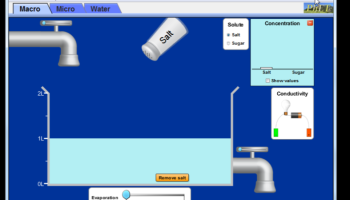
This is a series of experiments, PhET Interactive Simulation activities, and clicker questions to relate macroscopic and molecular representations of homogenenous solutions. Graphing skills are also used. Materials Access to PhET Inteactive Simulations -