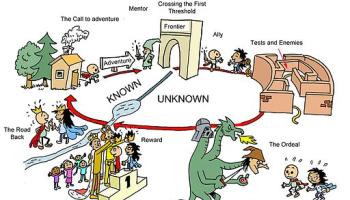
This is a new activity for chemistry students who struggle with the correlation between changes in enthalpy, temperature, entropy, and the Gibbs free energy of a system; which relies on an analogy that most students will be familiar with.
I remember my alarm waking me up early on a Saturday in December. Realizing my kids were still asleep, I pressed snooze so I could steal a few extra minutes of rest before the breakfast cheerios and cartoon chaos began. Before I could doze off again, my phone received an email notification. It was score day for National Board Certification.
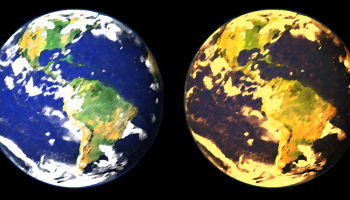
With Earth Day approaching, you might want to try out the experiment published in the Journal of Chemical Education.1 It outlines a fantastic way to demonstrate the warming influence that atmospheric CO2 has on our planet. I followed the procedure and offer a video of the results.2
This year I started asking students to complete a simple assignment at the end of every unit that has come to be known as “Careers in Chemistry”. The purpose of the assignment is to expose students to career options that use Chemistry that they may not know much about.
"In honor of the International Year of the Periodic Table this series of articles details the Element of the Month project developed by Stephen W. Wright (SWW), Associate Research Fellow at Pfizer Inc., and Marsha R. Folger (MRF), chemistry teacher (now retired) at Lyme – Old Lyme High School in Connecticut.
The periodic table of chemical elements is perhaps the most recognizable image in all of chemistry. Because it was discovered in 1869, the periodic table is celebrating its 150th birthday this year.
It is the time of year when POGIL workshops are being planned and registration is open. The facilitation teams are awesome and it is a very worthwhile experience, not just about POGIL, but about teaching, learning, and how we think about our students.
In late 2012, a group of prominent researchers gathered in the mountains of Colorado for a momentous summit on science education (see image 1). Sequestered away for 5 days, these researchers debated one of the most critical facets of teacher knowledge.
I was thinking about what I do as a chemistry teacher that is unique and other teachers might be interested in and it usually comes back to standards-based grading (SBG).
I was lucky enough to be selected to read the Advanced Placement Chemistry Exam in Salt Lake City, Utah this past June for the second time. Let me share some of the tips I learned.
I want to share a strategy that I have implemented in my classes this year and has been very helpful in establishing relevance to topics taught and in making connections between topics taught within a unit.