Welcome and thanks for reading. This post is the second that discusses the tantalizing chemistry related to the metabolic marvel of bear hibernation. Click here to read the first post.
When I tell people I teach IB Chemistry, I often get the following response, “Is that like AP?” Unfortunately it’s not that simple, so the next few blog posts will explain some key differences.
"In honor of the International Year of the Periodic Table this series of articles details the Element of the Month project developed by Stephen W. Wright (SWW), Associate Research Fellow at Pfizer Inc., and Marsha R.
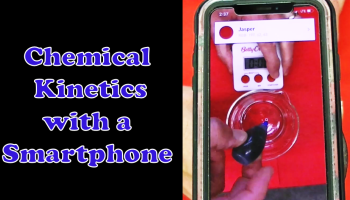
An article recently published in the Journal of Chemical Education by Ruth E. Nalliah1 describes a great experiment for studying chemical kinetics that is extremely simple to set up and carry out. The experiment involves monitoring the reaction between blue food dye and hydrogen peroxide in the presence of base:
For my daughter’s first birthday, we got a chemistry book for babies as a present. We were very excited to start reading it to her, especially since I have a master’s degree in chemistry and my husband has a master’s degree in chemical engineering.
The ACS Hach Professional Development Grant is open for applications. The grant funds professional development for high school teachers that will enhance your teaching skills and improve the learning of your students. Up to $1500 of professional development expenses may be covered by the ACS Hach Professional Development Grant. The professional development activities must take place by August 1, 2020.
The flipped classroom originated in Colorado when two Chemistry teachers, Jon Bergmann and Aaron Sams, started recording lectures for students to watch at home. They were driven to increase interaction with students when they seem to need it most, during homework.
Since the release of the National Research Council’s Framework for K-12 Science Education1 in 2011 and the subsequent Next Generation Science Standards (NGSS) that would follow in 2013, an increasing number of science educators have become familiar with the general idea of placing greater emphasis on science as a way of
Late autumn is soon to give way to the thermal rigors of winter and your local black (or grizzly) bear is about to take a long slumber after spending the past six months frantically- but with evolutionary precision and purpose- binge-eating whatever food was available. The purpose for such behavior?
One of the presentations I gave this summer was at the Massachusetts Association of Vocational Administrators using my vocabulary sort as a framework to talk about Modeling InstructionTM.
//Tuesday, November 5, 2019•Clarissa Sorensen-Unruh
A couple of days ago on Twitter, the ever-lasting debate between lecture and active learning reignited due to some talks at an Educational Research Conference held in Dublin. These talks stated direct guidance (which includes lecture) was superior in terms of student learning due its reduction of students’ cognitive load.