Gas Laws and the Over-Reliance on Algorithmic Thinking
As our Gas Laws unit was coming to an end, it was time to create the test. As I thought of potential test questions that were both challenging and in alignment with the learning objectives we had previously identified for the unit, I was reminded of a multiple-choice question I had been shown in an old Modeling InstructionTM resource.
Which of the following samples of gas will have the greatest pressure if they all have the same volume?
A. 10 moles at 80 0C B. 10 moles at 70 0C C. 5 moles at 81 0C D. 2 moles at 82 0C
I loved this question because it required a particle-level understanding of pressure. Since we continuously try to connect the macro level with the particulate level, it served as a useful conceptual question. More specifically, there is no memorized equation/formula that could potentially mask understanding and no mnemonic device to rely on. Instead, it just requires a moment in which you must stop and think about how the two variables, moles and temperature, relate to pressure. In other words, the only thing students need to do is ask themselves, “which of these answers would produce the most amount of collisions1 with the inner walls of the container?”
To be honest, I was pretty confident in my students’ ability to answer this question correctly. After all, the idea of pressure came up frequently throughout the unit which meant we had multiple opportunities to explain why pressure would increase or decrease from a particle-level perspective. Within these opportunities, feedback was provided with the hope that it would be used to improve future explanations and overall understanding. In fact, I saw the majority of students citing the concept of particle-wall collisions much more frequently after they were given time to acknowledge previous feedback.
However, as I was grading the tests, I started to notice something—many students were choosing answers that I had previously thought would have been easily dismissed. After I was done grading the tests, I decided to look at the data.
Which of the following samples of gas will have the greatest pressure if they all have the same volume?
A. 10 moles at 80 0C B. 10 moles at 70 0C C. 5 moles at 81 0C D. 2 moles at 82 0C
Out of 160 students:
16% (26) chose B—10 moles at 70 0C
17% (27) chose D—2 moles at 82 0C
How was it possible that 1/3 of my students got this question wrong?! After reflecting on this for a bit, here is what I think happened and how it reflects a recurring issue especially in science education.
Answer—10 moles at 70 0C
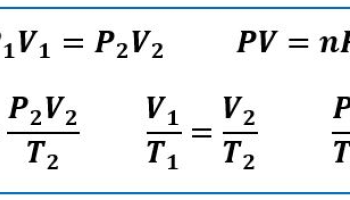
Of all the answers available, I thought this one was going to be the easiest to dismiss. After all, if answers A and B both had the same number of moles but one was at a lower temperature, how could the answer with a lower temperature possibly cause a greater frequency of collisions? It wasn’t until I started to look at some of the tests that I noticed some of the “work” students were doing on the side. Students were literally plugging in temperature values from answers A and B to a memorized equation (Gay-Lussac’s Law or the Combined Gas Law) which lead through a line of reasoning that appeared to go something like this:
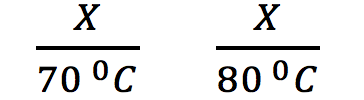
The bigger the bottom number (temp) the smaller the answer will be. Therefore, the smaller of these two temperatures will result in the greater pressure.
Forget the fact that it’s a complete misuse of Gay-Lussac’s Law or the Combined Gas Law. Forget the fact that the mathematical reasoning they were trying to use doesn’t even make sense. My biggest concern here was that the moment they saw some numbers, they instantly resorted to an equation, which was completely misused.
In case you’re wondering, nobody tried using the Ideal Gas Law.
To be clear, it’s not that I’m necessarily against using an equation to prove an answer to a conceptual question that could have easily been solved for after a moment of thinking about it. What is most interesting to me is the number of students that were SO RELIANT and SO CONFIDENT in their memorized formulas, that using them completely blocked out the thought process that would have allowed them to see the obvious contradiction in their answer.
So, what about the students that chose the other answer?
Answer—2 moles at 82 0C
I think the thought process that would lead someone to choose this answer is much easier to explain. Students knew about the directly proportional relationship between pressure and temperature. They reasoned that the higher the temperature, the more collisions. Therefore, they chose the answer with the highest temperature.
Though these students showed no evidence of plugging values into memorized formulas, I consider their error in reasoning to fall within the same category as the other group. Instead of resorting to a memorized formula, they instantly resorted to a memorized procedural relationship: As temperature increases, pressure increases. In doing so, it completely blocked out any consideration of the effect that the number of moles present in each sample would have or even the small discrepancy between temperature values among the answers available. Not only that, like the students from the other group, they misused the concept of Gay-Lussac’s Law by forgetting the fact that it’s only true when both volume and moles are held constant.
The two groups of students that I identified are made up of students with reasoning skills all over the spectrum and earned grades on this test anywhere from an A to a D. To make it even weirder, this specific test had the highest performance of any test we have had throughout the year with an average of 82.5%.
So Why Am I Even Bringing This Up?
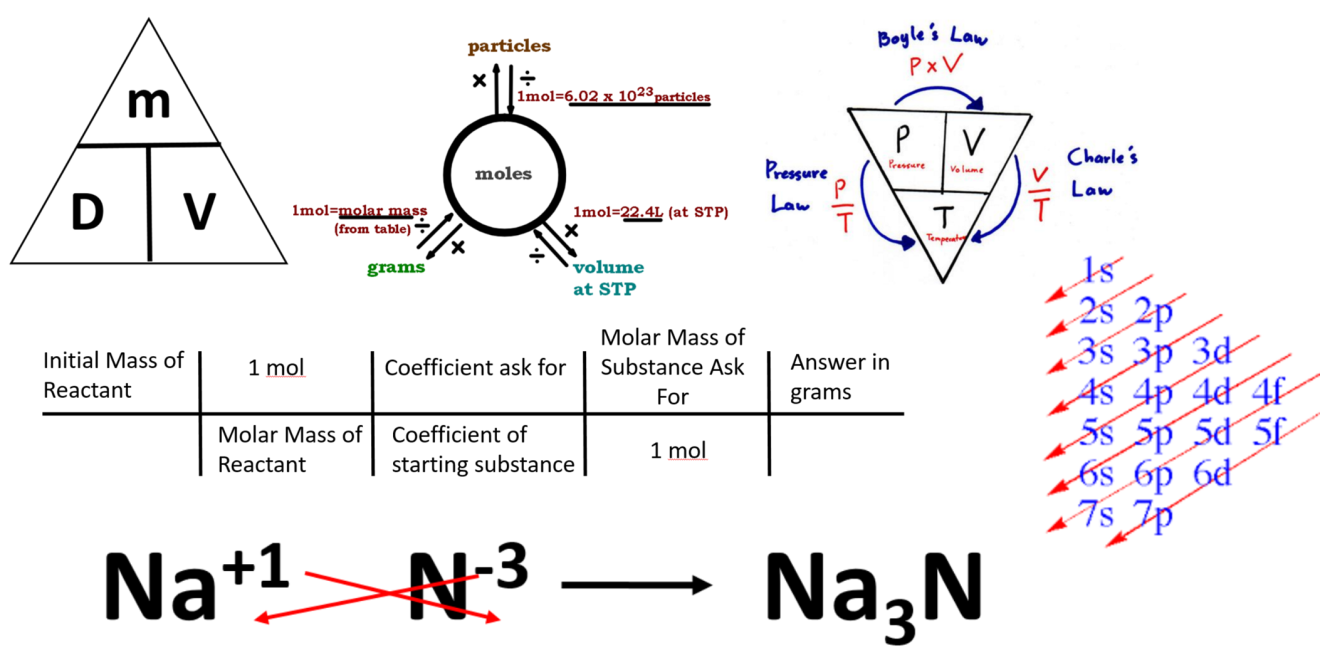
Regardless of the topic being taught, we can all think of situations or concepts that students typically resort to a more procedural way of thinking. Though the reason so many students approach many chemistry concepts this way is a topic that has been extensively researched,2-4 I still find myself continuously “battling” with students to overcome the attraction to constantly approaching problems with an algorithmic or procedural mindset. Even within the scientific education community, the idea of quantitative correctness equaling understanding is something that is prevalent and I think it continues to be partly responsible for advocating such an algorithmic approach. You see this with things like density triangles, stoichiometry calculations, mole conversions and even in topics that aren't necessarily quantiative like electron configuration and ionic formulas.5
Just to clarify, I did use a question from a Modeling InstructionTM resource as the basis of this post. I have been trained in Modeling InstructionTM but I am unable to use a full-blown version of the provided curriculum in my current teaching assignment. I do try to use many of the practices of Modeling InstructionTM but I neglected to use the PVnT tables that Modelers often use in the gas law unit. After seeing the above results, I am anxious to incorporate the PVnT tables into my gas law unit next year and compare the results for this question to what I saw this year.
What are some strategies you use to not only promote a conceptual understanding but also teach students when algorithms are beneficial and when it’s potentially inappropriate to use them? How do you convince your students and colleagues that just because students may arrive at the correct answer, that doesn’t mean they understand what’s going on. In other words, why is it so difficult to convince people that quantitative correctness doesn’t automatically suggest understanding? If you have any thoughts or recommendations on the matter, I would love to hear them. Though this was just one example, it’s one of many that occur throughout the year and I want to do anything I can to promote thinking skills and overall reasoning ability.
1Since pressure is not universally defined this way, I just wanted to provide a bit of clarity here. In Modeling InstructionTM, the concept of pressure is explained using a model that primarily focuses on the frequency of collisions between particles and inner walls of the container. The more collisions, the more pressure and vice versa. For example, we can account for the increase in pressure when the temperature of a system is raised since the particles have a higher average kinetic energy which leads to an increase in the frequency of collisions between the particles and the inner walls of the container that hold them. You can learn more about Modeling InstructionTM at http://modelinginstruction.org (accessed 3/20/17).
2 Cracolice, Mark, John Deming, and Brian Ehlert. “Concept Learning versus Problem Solving: A Cognitive Difference.” Journal of Chemical Education 85-6 (2008): 873-878
3 Gallet, Christian. “Problem-Solving Teaching in the Chemistry Laboratory: Leaving the Cooks…” Journal of Chemical Education 75-1 (1998): 72-77
4 de Vos, Wobbe, Berry van Berkel, and Adri Verdonk. “A Coherent Conceptual Structure of the Chemistry Curriculum.” Journal of Chemical Education 71-9 (1994): 743-746
5 This image includes topics in chemistry that often resort to "tricks" or "tools" that students are given to help find the correct answer. I know there are plenty of others, but these were just some of the ones that I could think of off the top of my head. They are not all equal with respect to their level of being a rote algorithim that promotes little to no thought from the student.

Ben Meacham
Though I have had the opportunity to teach a variety of science subjects, Chemistry has always been my passion.
Comments
18MC v. Free Response
I think this is tricky as a multiple choice question, but that students might do better if it were a free response. If the question were "Pick the flask with the highest pressure and explain your reasoning?", do you think more students would pick the right flask because they'd be force to think about a reason instead of just making an answer?
In reply to MC v. Free Response by Matt Ford
MC v. Free Response
Matt,
I definitely agree with the whole free response alternative. Using it as a free response question next time was honestly what I was thinking about as I was grading them. I think you're right in that students would have greater success if they were put in a situation where applying thought and actually writing it down as something that's required to complete the problem. Even if they resorted to their "algorithm", it would be much harder to defend through writing. Will most likely make this change next year.
I think the problem could be improved even more by making it more visual while incorporating your "pick the flask with the highest pressure" idea. I'm sort of envisioning 4 different flasks, some with a different number of particles, and even attaching "temperature arrows" to the particles to communicate relative speed. This might induce the concept of collisions and particles with greater ease.
Thanks for the insight!
I'm not sure it measures what you think it does...
The question, as asked, does not rely at all on the concept of particle collisions. You can figure it out solely from the Ideal Gas Law. Because all of the gases are in the same volume container we can solve for pressure as:
P = (nT)(R/V) = (nT)(constant)
The gas with the highest nT product will have the higher pressure. Because all of the temperatures are essentially the same in terms of Kelvin (343 K to 356 K) we can look at moles because the variation there is greater. The more number of moles the higher the product. We have two answers with 10 moles so we pick the one at the higher temperature. The answer therefore should be (a).
If you want to check their conception of molecular collisions and the effect on pressure, the question should be reworked as:
Five gases are listed below with their root-mean-square speeds. Which one has the highest pressure?
a. 235 m/s b 775 m/s c. 1843 m/s d. 673 m/s e. 1194 m/s
Here they need to understand that the higher the average molecular speed, the more collisions with the walls and therefore, the higher the pressure. Giving moles and temperature at a constant volume doesn't REQUIRE a molecular/particulate understanding of pressure. It can be done that way but it's not necessary.
John Milligan
In reply to I'm not sure it measures what you think it does... by John Milligan
Hi John,
I think Ben's point (and correct me if I am wrong) is that you could solve a lot of problems by just plugging it into an equation but we would rather have students go to their conceptual understanding first. You make a good point that the temperatures are very similar but the mole values are very different, thus eliminating two answers. A student could still get to the same answer you did by evaluating the problem conceptually: if two containers have the same number of particles and the particles are moving faster (higher T) in one container, the particles would collide more with the surface of the container, creating a higher pressure.
I prefer my students to fall back on their conceptual understanding of the gas laws when answering a question like this as opposed to a mathematical understanding. I also use the PVTn tables from the Modeling Instruction pedagogy instead of the combined gas law so my students are not falling back on an equation.
Ben, you mentioned moving to these tables next year; I highly recommend it. The PVTn tables, like the BCA tables from Modeling Instruction, really push students to rely on their conceptual understanding of the topic as opposed to an algorithmic understanding. This year I really focused on building strong proportional reasoning skills from day 1 and it has been paying off all year. I lost some time in the beginning of the year from this investment but I have gained it all back and more because my students have been grasping difficult concepts more quickly. I'm sure it is not a popular approach to abandon dimensional analysis and most equations in a chemistry class but I think it is worth it.
Thanks for the insight Ben! I definitely agree that is a constant uphill battle!
In reply to Hi John, by Lauren Stewart
Conceptual Understanding...
I get that you, and all of us, want them to have a conceptual understanding of the topics we teach in chemistry. I am just arguing that with a MC question like what was proposed you do NOT have to rely on a conceptual understanding. If you are going to go with a MC question, which I never do because they never evaluate what we think they do, the modification I made would force them to rely on a conceptual understanding instead of being able to solve it mathematically, which they should be able to do also.
A student with a conceptual understanding that cannot solve unique and novel problems presented to them is not a student that should be considered to pass the class. All of my exams, I teach at the community college level, are problem solving based. If the problems are set up correctly, they will require an understanding of the concepts to solve it.
I understand the desire to have MC exams. It makes the grading SO much easier. However, what is the cost of that?
In reply to Conceptual Understanding... by John Milligan
Validity of question and conceptual understanding
John,
I'm going to try to provide a bit of clarification and address several things you mentioned in both comments.
1) "The question does not rely at all on the concept of particle collisions."
Though I agree with you that the question does not REQUIRE a particulate understanding of pressure, it's simply not true to imply that an understanding of particle collisions plays no role in successfully answering the question. Looking back, instead of saying "it requires a particle-level understanding of pressure," I should have said something like "it promotes an understanding of pressure that is primarily tied to an awareness of what takes place at the particle level." Semantics aside, one thing should be obvious from the question--it most certainly suggests to the student that solving the problem is likely to be different than solving an Ideal Gas Law problem that asks for a numerical answer. Because of this, the majority students are likely to solve using their understanding of particle collisions and reasoning their way through the 4 situations provided--which is exactly what I saw from the test. The fact that some opted to use a mathematical model to solve the problem does not mean the question didn't measure what I had originally intended. It simply means that the question left a window of opportunity (one that is far less likely to be used) for solving it with a mathematical model. In addition to this, another claim should be valid--the average student who successfully answered the question is more likely to have a conceptual understanding of pressure than somone who unsuccessfully answered the question. Though the question may not be perfect, it assessed exactly what I thought it would and displayed the number of students that still lacked an understanding of what pressure is. That claim is not equivalent to saying the student who correctly answered the question without math has a better conceptual understanding of pressure than the student who correctly answered the question using math. In summary, the question most certainly promotes a way of thinking that displays a conceptual understanding of pressure, even if it's possible to solve using a more algorithmic approach.
2) Rephrasing the question to include "root-mean-square speeds" as a way of determining greatest pressure.
Though your potential question is completely valid and accurate, it is completely inappropriate for a general chemistry high school setting. At the high school level, I have never, and would never, teach my students the idea of temperature with such a mathematical understanding. The description of temperature as a measure of the average kinetic energy of the paritcles is more than adequate for solving any problem they are likely to encounter. This doesn't mean that the question isn't appropriate at any level, since it may very well be a question I can imagine you would expect your college students to solve. However, I would hope that you could see the distinction between levels and average mathematical reasoning ability likely to be present at the high school level.
3) "Multiple-Choice questions never evaluate what we think they do."
I think it's valid to claim that MC questions have a greater potential to be misinterpreted/misused than other types of questions. However, to say that MC questions never evaluate what we intend is simply not true. If written correctly and reviewed to a certain extent, they can certainly measure exactly what we want them to. I've spoken with a member of the ACS Board of Trustees, who are responsible for all national chemistry examinations, and they include MC questions for exactly that purpose. If a question is worded improperly, they talk about it, consider potential misinterpretations (which are often unlikely anyways) and make the necessary changes so that it's clear what the question is evaluating.
4) The cost of MC exams.
To clarify, this MC question was one of just a few from the test. It was hardly a MC exam. If the creation of the test was solely up to me, which it's not, I would not include any MC questions. But that's only because, like you, I'm more in favor of exams that have fewer questions but require problem solving skills that are more likely to demonstrate an understadning, or lack thereof, of the content.
To summarize all of this, I want you to know that we do agree on the following:
a. The problem does not REQUIRE a particulate understanding of pressure
b. The problem can be solved using the Ideal Gas Law
c. The concept could potentially be evaluated by including the idea of root-mean-square of velocity
d. Multiple-Choice questions can easily be misinterpreted and not evaluate what we want if written inappropriately
With all being said, I understand your points and, in the spirit of meaningful discourse, I would hope that you would understand my responses to them. I hope that we realize common ground and, though we may disagree on some issues, value each other's insights.
MC vs Free Response
What do you do when you have free response questions and your students use "sound logic" to come to wrong conclusions?
I teach a math class and a lot of my problems ask the students to solve a math problem and put it into context based upon their understanding of the topic. It seems like no matter the topic, your preconcieved idea about the "truth" does not apply at all times. I give out a KEY for all the quizes so students can see how I solved the problems and why I made the decisions I made. But, I make sure to tell the students if they use sound logic to make their argument, no matter what that argument is, they get full credit.
In my class, I asked about the dangers of smoking and saving for the future. If a student has a rare disease that will kill them by the age of 50, use your typical arguments for saving for the future and not smoking.... Right. You can't.
In your case, all pressures are 0. Here's why. You said they have the same volume. Therefore, I say volume equals infinity. Now, how many points do I get? You say, well based upon the formulas.... I say, because temperature refers to the average speed the particles are traveling at, and they have infinite space in which to roam, and because the particles are so small in relation to the size of the space they have to roam, there will be no interactions. Now what? Points me!!!
You also have to look at leading and trailing questions, just like a good survey. What question(s) did you put down before this question?
In a survey, I can get you to answer the questions the way I want you to by asking questions a certain way and by giving leading questions. Before I give out a survey, I need to give out practice surveys to see if I do have a leading question. It doesn't matter if I think there are leading questions. All that matters is how my participants think. Once you know that, you can almost get into mind control...... (No, seriously!)
In reply to MC vs Free Response by Andrew Ekstrom
If a student gave your 0 pressure answer in my class, I would be thrilled! That answer shows a deep level of conceptual understanding. That is the beauty of having students explain their logic. Sometimes they are more creative than us, solve a problem a different way and we get to learn too! I use standards-based grading so I do not award points but that answer would be a "got it" in my class.
It all comes down to the learning target. If the student demonstrates mastery of the intended learning target in a different way then you expected, mastery is mastery. If the student does not demonstrate mastery on the intended learning target but has sound logic, maybe you just have no evidence of mastery yet, not 0 points.
In reply to If a student gave your 0 by Lauren Stewart
An answer of 0...
does not show a deep level of conceptual understanding. A conceptual understanding MUST be grounded in a physical reality. Simply making the container infinite in size does not correspond to physical reality. It may be a "logically correct" answer but the premise that went into the logic is flawed which makes the overall logic flawed and the answer irrelevant.
We all want to teach our students to think critically. This entails understanding when a logical argument is flawed because of bad premised. If we are trying to teach them to do science which is a way of understanding and exploring the physical world in which we live, then their arguments have to be based in that physical reality. Stating that the volume is infinite shows no understanding of a physical reality. If they can't ground their argument in physical reality, then they haven't shown mastery of the subject. Making the volume equal to infinity is just a lazy way of getting out of doing any thought or real argumentation about what the answer should be and show 0 mastery of the subject, therefore 0 points. 0 times infinity is not equal to a finite number (nRT). It's undefined.
In reply to MC vs Free Response by Andrew Ekstrom
Pressures all equal to zero is a BAD answer!
If the student responded that the volume of the container was infinite so therefore the pressure is equal to zero, that's how many points I would award that answer. It is logically consistent but not consistent with reality. If the volume of the container is infinite, then there are no walls to it. With no walls for the molecules to impinge on, the meaning of pressure disappears. There has to be something for the molecules to press against for there to be pressure. An infinitely large container doesn't correspond to reality so even thought it's a logical answer, the premise is invalid.
Having a logical conclusion only matters if the premises are valid.
In reply to MC vs Free Response by Andrew Ekstrom
"sound logic"
Andrew,
Your comment made me think of 2 things:
1) When students use "sound logic" but come to the wrong conclusion.
This made me think of what happens sometimes when my students are creating a scientific explanation using the Claim, Evidence, Reasoning framework. Once in awhile, I'll get a student who states an inncorrect claim (e.g. wrong unknown identified) but backs up the claim with sufficient evidence and appropriate reasoning. Though the student's claim is false, I give the student credit for his ability to provide evidence and reasoning in a way that is consistent with what I expect. However, I do not give full credit since the "answer" itself was incorrect.
2) The "all pressures are 0" idea.
First off, I'll give you props for the mental contortions you had to execute to pull this one out. However, instead of addressing the validity of this idea, I'll just provide my own insight toward what I would do if this situation was to arise.
Not a single one of my students possesses the background knowledge or reasoning ability to come up with such a dramatic example. Because I consider this example to be on the extreme side on the spectrum of potential interpretations, let's just pretend a student had come up with a less dramatic interpretation. I would have a 1-on-1 conversation with that student and if she could convince me that her claim is accurate and I felt she met the appropriate level of understanding for what that problem assessed, then I would give her credit.
The important thing to consider is whether or not the student demonstrated an understanding of what was being evaluated from the question. If students want to come up with an example that appears to be based in some sort of alternative reality or completely outside the realms of reason, then my solution is simple--no credit.
I understand the point you brought up about surveys but this particular question was clear enough that diving into surverying techniques seems to be irrelevant. Doesn't mean that the question was perfectly worded but it's lack of ambiguity makes it highly unlikely to result in some sort of dramatic misinterpretation.
Regardless, your comment reminds me to always be aware of what exactly I'm asking when coming up with a question.
Yes, the universe is smaller than infinity... but so what?
The idea behind something of infinite volume is that the volume you open the system to is significantly larger than the original container.
If I open a tank of nitrogen inside a 100,000 Sq ft warehouse, will there be a change in pressure? None that we will ever be able to detect. Can we calculate a potential change in pressure? Yep. Do the results mean anything? Nope!!!
If I open the gas cylinder in my back yard, same thing. Meaningless results.
What about on Jupiter? The moon? Granted, the universe is significantly smaller than infinity. But, I don't care. The pressure due to the moles of gas in the original question is still zero.
All cuz the volume of my system is significantly (infinitely) large.
Can I use this discussion in my ACS talk?
I will be presenting our new mobile tool, the Animator, at the ACS meeting next week in San Francisco as part of the symposium on E-learning (Monday morning). I would love to use this problem and discussion as part of that talk. This app's development came directly from my experience as an AP chem teacher and wanting to get students thinking and understanding chemistry at a particulate level. (Here's a post about the app. Not quite released, but almost!) I will DM most of you to get feedback.
In reply to Can I use this discussion in my ACS talk? by Julia Winter
Using this discussion
Julia,
Absolutely. Anything to help your cause. Love the idea behind "the Animator" by the way!
"Sound Logic"
I try to put sound logic in quotes because there really is no such thing as "sound logic". Just "logic" derived from your understanding of what is going on and your personal beliefs. Logic changes based upon how you look at a problem.
I teach math classes. I really couldn't care less what answer they get from an equation. Getting the "right" answer is usually 1-2 points out of 10. The use of that answer is what I'm most interested in and 4-5 points out of 10. I also teach my students that hte 2 most important questiosn they can ask in a class are:
1) When am I going to use this crap?
2) What can I do with this information?
I also tell them that there are stupid questions but, I highly doubt any of them will ask one.
I also use chemistry related questions all the time. It annoys some students. But, they know it is useful sometimes in their lives.
Suppose that you ask a question about a weak acid pH. When you solve the quadratic, you get one positive and one negative value for X. Since X the concentration of [H+], I'll ask what does the negative value tell you? What does it represent? Math says it exists. But, is it relevent?
In my P-chem classes and A-chem classes, we learned that chemical kinetics are deterministic. Since, at large numbers of molecules (say 0.10moles), we get about the same answer, every time we run the experiment, a deterministic model seems to fit. It makes "sense". It seems "logical". It is part of our tradition.... If you don't have a good understanding of applied mathematics or applied probability or look at ultra low concentrations of molecules, like those in a cell. Once you take an applied probability class, or take a probability class and apply it yopurself, you realize chemical kinetics are actually probabilistic. Part of my PhD thesis is looks at this type of modeling regime.
For my models, I decide that the probability of a reaction accuring is small, say 0.000000001. But, if I say this probability is for a chemical reaction within a femto second, and I am growing monomers into 50,000+ mer unit polymers, I get to 50,000+mer unit polymers within seconds. If you don't understand probability, this seems completely illogical. However, the probability theory behind this idea is several 100's of years old. This particular application is about 30 years old. Through a typical chemical education, this exercise is completely pointless and illogical. However, from an alternate point of view, it's completely logical and rather boring.
I can use my "sound logic" to "prove" I am correct. I can use data to show deterministic models fail at the small scale. I can use my models to "prove" they work at large and small scales. I can show, with physics and applied math books that my models work.... But, most of the chemists I know won't change their point of view..... because it defies their logic.... I.E, they have an alternate point of view.
Share Your Thoughts