Chemical Kinetics with a Smartphone
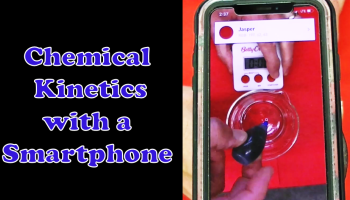
An article recently published in the Journal of Chemical Education by Ruth E. Nalliah1 describes a great experiment for studying chemical kinetics that is extremely simple to set up and carry out. The experiment involves monitoring the reaction between blue food dye and hydrogen peroxide in the presence of base:
Blue dye #1 + H2O2 à colorless products Equation 1
This article piqued my interest so I decided to try it out for myself. When doing so, I made a few modifications. I found that it was quite simple to monitor the kinetics of this reaction using an iPhone outfitted with the RGB analyzer app called “Color Name”. You can see the overall process of how I carried out the experiment as well as collected and analyzed the data in the video below.
The goal of the experiment is to determine the order of the reaction with respect to the blue dye:
Rate = k[dye]x[H2O2]y Equation 2
Where “Rate” is the rate of the reaction, k is the rate constant for the reaction, x is the order of the reaction with respect to the dye, and y is the order of the reaction with respect to H2O2. The reaction is run with a very large excess of H2O2, therefore the concentration of H2O2 essentially remains constant throughout the reaction. As a result, we can treat k[H2O2]y as a constant, and Equation 2 may be written as:
Rate = k’[dye]x Equation 3
Where k’ = k[H2O2]y. If the reaction is first order in the dye, the following equation can be used to describe the concentration of the dye at various time intervals:
ln[dye]t = ln[dye]0 - k't Equation 4
Where [dye]t is the concentration of the dye at the beginning of the experiment and [dye]0 is the concentration of the dye at some time, t, during the experiment. Equation 4 takes on the form of a line if we let y = ln[dye]t , b = ln[dye]0, m = k’ and x = t. Because of this, if we plot the natural log of the dye concentration vs. time, a straight line will result if the reaction is first order in the dye. Furthermore, the slope of the resulting line is equal to the opposite of k’ (Figure 1).
![First order plot of ln[dye] vs. time](/sites/www/files/styles/xxl_full/public/first_order.png?itok=yuRghIIO "First order plot of ln[dye] vs. time")
Figure 1: First order plot of ln[dye] vs. time. The straight line indicates the reaction is first order with respect to the dye concentration. The slope of the line yields the rate constant for the reaction (k’ = 0.47 s-1)
On the other hand, if the reaction is second order in the dye, then the equation below should be used to describe the concentration of the dye at various time intervals:
1/[dye]t = 1/[dye]0 +k't Equation 5
In this case, we get a line if we let y = 1/[dye]t, b = 1/[dye]0, k’ = m and x = t. Thus, if the reaction is second order in dye concentration, a plot of 1/[dye] vs. time results in a straight line with a slope = k' (Figure 2). Thus collecting [dye] vs. time data and constructing the accompanying first and second order plots can provide insight into whether the reaction described in Equation 1 is first or second order with respect to the dye.
![Second order plot 1/[dye] vs. time](/sites/www/files/styles/xxl_full/public/figure_2_5.png?itok=A6HChoIy "Second order plot 1/[dye] vs. time")
Figure 2: Second order plot of 1/[dye] vs. time. The straight line indicates the reaction is second order with respect to the dye concentration. The slope of the line yields k' in Equation 3 (k’ = 1.38 M-1 s-1)
Because the dye is colored blue, it can be monitored by measuring the amount of red light that passes through the dye in the reaction mixture (recall that blue dye absorbs red light quite well).2 Thus, the RGB app on the smartphone can be used to measure the red light that passes through the solution. Recall that the absorbance, A, of a dye is directly proportional to its concentration:
A a [dye] Equation 6
Because of this direct relationship we can use absorbance as a measure of dye concentration. Note that in the context of this experiment, the RGB app on an iPhone is used to monitor the amount of red light that passes through the blue dye. The absorbance at each time interval is calculated as:
A = -log(R/R0) Equation 7
Where R is the amount of red light transmitted through the solution and R0 is the amount of red light that passes through the solution when it is colorless (which is essentially the “blank”).
I had the opportunity to try this experiment out with students and it worked very well. If you use this experiment, let me know how it works for you. Also let me know if you monitored the reaction using the method described in the article or by using the RGB app. I’m curious to hear about any other variations you might try!
Editor’s Note (10/22/20):
- The apps suggested here may not keep up with the changes as smartphones are updated. Please share in the comments if you have found apps that work well with android and/or IOS. As of this note, Color Name is one recommended RGB app. Try Color Grab for Android.
- Tom Kuntzleman published a related activity introducing the procedure of using the smartphone as a spectrophotometer. You will find it linked in the reference section below.
References:
- Ruth Nalliah, Reaction of FD&C Blue 1 with Sodium Percarbonate: Multiple Kinetics Methods Using an Inexpensive Light Meter, Journal of Chemical Education, 2019, 96, 7, 1453 -1457. (accessed 11/26/19)
- Kuntzleman, Tom, Use Your Smartphone as an "Absorption Spectrophotometer", ChemEd X, 3/30/16. (accessed 11/26/19)

Tom Kuntzleman
I have taught science at all levels from Kindergarten through upper division undergraduate. Member of ACS, AACT.
Comments
7Order of Reaction
Wondering if you'd be willing to answer some questions offline regarding this experiment. I used it with my class this week and all groups found the reaction to be first order with respect to the dye. The R^2 value for the ln(abs) plot was closer to 1 than it was for the 1/abs plot.
In reply to Order of Reaction by Stephen Pulliam
Nice work!
Stephen:
Looks like your students do more careful work than I do...The author of the article I reference (Journal of Chemical Education, 2019, 96, 7, 1453 -1457) also found the reaction to be first order in the dye. Tell your students I said that they did great work!
Tom
In reply to Nice work! by Tom Kuntzleman
Thanks Tom. I appreciate your reply. My students will be glad to know that they were spot on!
Commentary to the mathematical development
I have done the experiment with my first year chemistry student. It works very well. I'm thrilled to have a kinetic experiment that is accessible and fun to do. When students are put in pairs, they need to collaborate effectively to make the measurements on time. I make them practice the 15 seconds interval before doing the actual experiment, because there is a lot to handle at the same time.
Some phones needed more light than others to reach a reasonable R blank(more than 210). I needed to change their location in the class in order for them to get more light.
The main point of my commentary is on the mathematical development you discuss.
1) for equation 3, you say k' = [H2O2]^y . It should say k' = k • [H2O2]^y
2) I would add a line between the equation of dye concentration and the equation of rates, to make it clear that a mathematical process has been used to obtain one from the other. You don't have to say that it's derivatives and integrations, but a transition is needed.
3) the actual equation that links dye concentration at time t to the dye concentration at time 0 when the order of y = 1 must be " ln[dye]_0", not directly [dye]_0. One way to write it is: ln ([dye]_t / [dye]_0) = -k' • t
4) similarly, the real equation linking [dye]_t to [dye]_0 when the order of y is 0 should be: [dye]_0 - [dye]_t = k'•t
5) in equation 5, the integration will depend on the chemical equation. If 2 reactant A becomes 1 product, there will be a 2 in the time term: 2•k'•t
Because in the end, in my course, I only ask students to decide which order seems to be the correct one, the mathematical details are not important. I follow the steps you describe in the video to obtain the R^2. In this regard, I don't even bother finding the precise Beer-Lambert Law, with it's own constant. It's the slope that is important. But if a colleague would ask the student to find the mathematical values of k', it's important to note the difference.
Share Your Thoughts