Gases

bucket launch
// Monday, January 16, 2017 Tom Kuntzleman
In Chemical Mystery #9, a 5-gallon bucket is launched into the air using the energy released during gas explosions. These explosions result from gas pressure buildup inside a sealed 2 L soda pop bottle. Two slightly different methods of launching the bucket are used, and one works better than the other. Why does one method work better than the other?
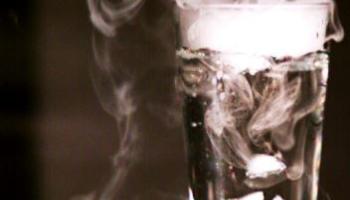
Cloud formed when dry ice is placed in water
// Sunday, December 4, 2016 Tom Kuntzleman
Have you ever wondered where the cloud comes from when dry ice is placed in water? Consider the answer returned in my browser when I Googled the phrase “How does the dry ice cloud form”:
flame on black background
// Sunday, October 23, 2016 Doug Ragan
I have always been intrigued by the story of the Hindenburg, the iconic airship that caught fire on May 6, 1937.
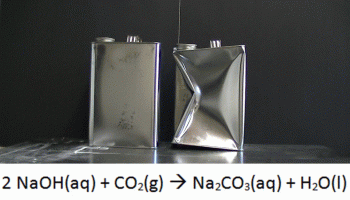
Crush a can with chemistry
// Sunday, June 5, 2016 Tom Kuntzleman
In Chemical Mystery #6, I used chemistry to crush a metal can. To do so, concentrated sodium hydroxide solution (about 35% NaOH by weight) was added to a can that was almost completely filled with carbon dioxide gas. The can was then sealed. The carbon dioxide gas in the can reacted with the added sodium hydroxide:
// Tuesday, May 17, 2016 E Posthuma
For my students and me, the AP Chemistry exam does not mark the end of the school year. Once the AP exam is over, my students are exhausted but our class continues to meet for three more weeks. Each year we complete a qualitative analysis lab, but this year we finished earlier than I anticipated. For the first time all year, I have the luxury of time.
propane gun
// Wednesday, August 5, 2015 Tom Kuntzleman
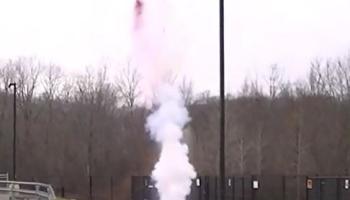
You HAVE to build one of these for your chemistry classroom. Your students are going to love this! At this site*, you can learn how to build a propane gun. In the video below, you can see the propane gun in action:
Balloon cooled in liquid nitrogen
// Tuesday, February 17, 2015 Tom Kuntzleman
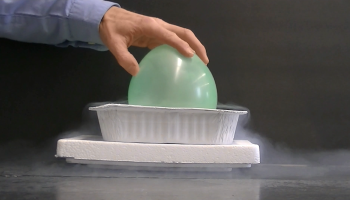
Did any of you guess what was going on in Chemical Mystery #4:  The Case of the Misbehaving Balloon?  In this experiment, several balloons were placed in liquid nitrogen.  Most of these balloons shrunk tremendously – to almost zero volume – when cooled
// Friday, February 21, 2014 Tom Kuntzleman
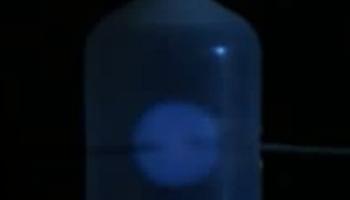
The nail bottle demonstration1 is one that many of us have conducted in our classes. To perform this demonstration, 2 – 3 mL of ethanol is placed into a plastic bottle that has two nails punctured into opposite sides of the bottle. After stoppering the bottle, a Tesla coil is touched to one of the nails.