Einstein 1905: The Standard of Greatness
This year marks a century since Albert Einstein published five of the most influential papers in the history of science, all submitted between March and September of 1905.
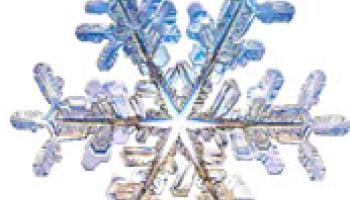
How do you know that no two snowflakes are exactly alike? Does it matter? For the scientist, the similarities between snowflakes are just an interesting, and probably much more important, than their differences. The author of the text in "The Snowflake" is Chairman of the Physics Department at Caltech.
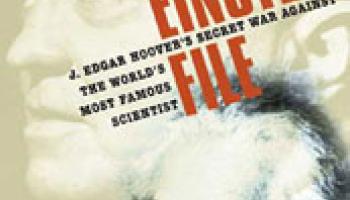
Most people would be surprised to learn that, by the time of his death in 1955, the FBI had compiled a file of more than fourteen hundred pages on the world's most famous and most revered scientist, Albert Einstein.
In his surprise 1959 bestseller about Kepler, The Sleepwalkers, Arthur Koestler claimed that Nicolaus Copernicus' book, De Revolutionibus had very little influence on the other astronomers of his time because it was little-read.
Robert Hooke's name is familiar to most of us only because of "Hooke's Law", f = - kx, which describes the potential for a harmonic oscillator. I became aware of some of the other contributions of this remarkable man by reading one of Lisa Jardine's previous books, "Ingenious Pursuits", which was my pick for May, 2000.
This is a terrific book. I thoroughly enjoyed every page written by distinguished string theorist Brian Greene, who also wrote the book and Nova TV series, "The Elegant Universe", which is available in paperback.
What would you say are the greatest scientific ideas that mankind has discovered? Most of us chemists would say that the notion that matter consists of atoms would have to be one of them, and physical chemist Peter Atkins does not disappoint us on that score. He also treads ground familiar to us when he describes entropy and energy, and evolution and DNA.
Many teachers of science use the automobile to exemplify the principles they wish to teach, whether it be the mechanics of acceleration or angular momentum, gearing, or the aerodynamics of drag.
This is a sequel to Ehrlich's "Nine Crazy Ideas in Science", which was my pick for December, 2001. I don't think it is as good as the first one, although it does have some great strengths; his discussion of the climate change issue is about as good as any, and he also has an especially good discussion of the efficacy of placebos.
I am always looking for science/engineering projects that would be fun to do, and to encourage students to try. Neil Downie's first book, "Vacuum Bazookas, Electric Rainbow Jelly, and 27 Other Experiments for Saturday Science" was a Pick for March, 2002.