Thermochemistry

Energy changes and transfers, endo and exothermic, law of conservation of energy

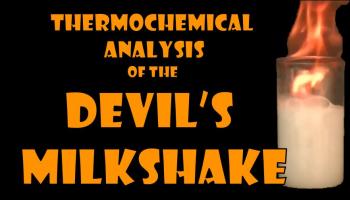
Analysis of Devil's Milkshake
// Wednesday, October 28, 2020 Tom Kuntzleman
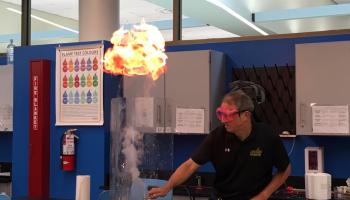
A year ago I stumbled across a fun way to present the reaction between calcium metal and water. Check it out (including a video explanation): The Devil's Milkshake. Ca(s) + H2O(l) → CaO(s) + H2(g)       Equation 1
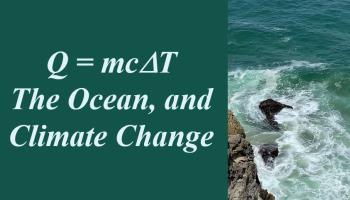
Text: Q = mcDT  The Ocean and Climate Change
// Friday, October 16, 2020 Tom Kuntzleman
For the past few years when I’ve been covering introductory concepts in thermodynamics, I’ve made a connection to climate change. My students and I calculate the energy that has been gained by Earth’s oceans as heat, using the following equation that is familiar to students of introductory and general chemistry:
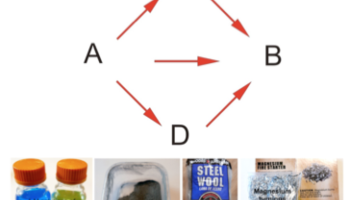
diagram of three reaction routes to same product and images of substance  used in activity
// Sunday, August 2, 2020 Philip Penketh
Prologue: The application of Hess's Law frequently presents students with conceptual problems, and I believe that performing a series of experiments that confirms Hess's Law, is probably the best way to impart a robust understanding of this principle. A plaque on the wall of the Oxford University Biochemistry Department reads:
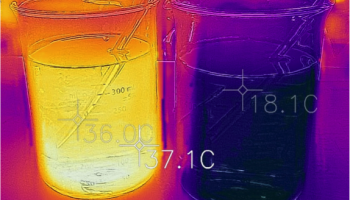
infrared image of the process of dissolution
// Wednesday, January 15, 2020 Ben Meacham
One of the inherent challenges of teaching chemistry is to make the invisible, visible. Often, we try to overcome this barrier by getting creative with a variety of models, animations, and simulations to help students think about chemistry in a way that is easier to conceptualize.
bear silhouette
// Monday, December 2, 2019 Scott Donnelly
Welcome and thanks for reading. This post is the second that discusses the tantalizing chemistry related to the metabolic marvel of bear hibernation. Click here to read the first post.
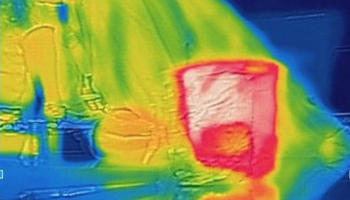
IR camera image of student and beaker at lab counter
// Tuesday, April 30, 2019 Lauren Stewart
This past school year, I had the opportunity to participate in the AACT Science Coaches program. When I applied for the program, I expected to be partnered with a professor, probably someone who had been in academia for quite awhile. I thought that this person could share their research with my students and maybe help me with some content questions.

legs by a vehicle and a wallet with cash
// Thursday, April 4, 2019 Kristen Drury
This is a new activity for chemistry students who struggle with the correlation between changes in enthalpy, temperature, entropy, and the Gibbs free energy of a system; which relies on an analogy that most students will be familiar with.