Seashell Chemistry
An experiment that has always fascinated me is observing what happens when CO2 is bubbled into limewater (which is a saturated solution of calcium hydroxide).1-2 This experiment can be carried out by blowing bubbles of exhaled breath (which contains roughly 4% CO2)3 through a straw into limewater. A series of reactions convert the calcium ions in the limewater into calcium carbonate:1-2, 4-8
CO2(g) ⬌ CO2(aq) Eq. 1
CO2(aq) + H2O(l) ⬌ H+(aq) + HCO3-(aq) Eq. 2
Ca2+(aq) + 2 HCO3-(aq) ⬌ CaCO3(s) + H2O(l) + CO2(aq) Eq. 3
These reactions are instrumental in the formation of CaCO3 in many marine organisms.4-8 In the reaction between CO2 and limewater, the formation of solid CaCO3 causes the mixture to gain a milky white appearance as the reaction proceeds. A curious effect happens if one uses dry ice (solid CO2) as the source of CO2 instead of exhaled breath. In this case, the CaCO3(s) that forms at first dissolves as the CO2 from the dry ice continues to bubble through the mixture (Video 1).
Video 1: Seashell chemistry, Tommy Technetium YouTube Channel (accessed 5/30/2023)
Notice that the system of Equations 1-3 can be simplified by adding them together (Eq. 1 + twice Eq. 2 + Eq. 3). Doing so yields the following:
Ca2+(aq) + CO2(g) + H2O(l) ⬌ CaCO3(s) + 2 H+(aq) Eq. 4
While different than other presentations of this system,4-8 I have found Equation 4 to be quite helpful in explaining to students how the limewater alternately forms or dissolves CaCO3, depending upon the conditions of the experiment. Inspection of Equation 4 indicates that both the presence of CO2 and H+ will impact which way the reaction will proceed. That is, the principle of Le Chatelier assures us that increased CO2 pressure should favor the formation of CaCO3, while increased H+ should favor its dissolution. But here’s the rub: dissolved CO2 concentrations increase with CO2 pressure (Equation 1), and increased CO2(aq) increases H+ concentration (Equation 2). Therefore, the presence of CO2(g) introduces competing effects into the system: CO2(g) is required to form CaCO3, but too much CO2(g) can cause the acidity to get too high, dissolving the CaCO3.
Going further
I have quantitatively analyzed Equation 4 with my students to provide further understanding of how the reaction behaves upon addition of dry ice to limewater. Specifically, we look at how the reaction first forms CaCO3, which then later dissolves. To start off, using Gibbs energies of formation (Table 1), we calculate the Gibbs energy of the reaction outlined in Equation 4 under standard conditions (

) to be +36 kJ mol-1. The positive value of
indicates that CaCO3 will not form under standard conditions.
Table 1: Standard Gibbs Energies of formation of substances in Equation 4.9
|
Substance |
DGfo / kJ mol-1 |
|
Ca2+(aq) |
-554 |
|
CO2(g) |
-395 |
|
H2O(l) |
-237 |
|
CaCO3(s) |
-1129 |
|
H+(aq) |
0 |
But the reaction is not carried out under standard conditions. To find the Gibbs energy of the reaction under the nonstandard conditions (

) of the experiment, we use the following:

Eq. 5
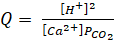
where R is the gas constant (8.314 J mol-1 K-1), T is temperature, and Q for Equation 5 is:
Eq. 6
Substitution of Equation 6 into Equation 5 yields the following, which we use to calculate the Gibbs energy of the reaction:

Eq. 7
When the dry ice is first placed into the limewater, a good estimate for the concentrations of all species is [H+] = 5 x 10-13 M, [Ca2+] = 0.0108 M, and PCO2 = 1 bar (see Appendix). Plugging these values, T = 298 K, and

= + 57 kJ mol-1 into Equation 7 yields
= -72 kJ mol-1. The negative sign for

indicates the reaction outlined in Equation 4 is expected to be spontaneous when the dry ice is first added to the limewater, forming CaCO3(s) – consistent with observations. However, after the dry ice has been allowed to bubble through the limewater for quite some time, the pH drops. A good estimate for the [H+] at this point is 1.2 x 10⁻⁴ M (see Appendix). Inserting this value, [Ca2+] = 0.0108 M, PCO2 = 1 bar, T = 298 K, and = + 57 kJ mol-1 into Equation 7 gives
= +23 kJ mol-1. In this case the Gibbs energy for the reaction is positive, and the reaction is spontaneous in the reverse direction. The CaCO3 dissolves!
Conclusion:
This demonstration provides a rich assortment of chemical topics to discuss, including chemical thermodynamics, chemical equilibria, solubility product constants, and acid-base chemistry. I generally use this demonstration to illustrate to students how to calculate the Gibbs energy of a reaction under nonstandard conditions (Equation 5). When doing so I give students estimates for [H+], [Ca2+], and PCO2, but don’t go through the calculations that justify these estimated values. This demonstration also provides a fantastic demonstration for the potential deleterious effects of increased CO2 concentrations in Earth’s atmosphere due to the burning of fossil fuels. As the atmospheric CO2 has risen, so also has the acidity of Earth’s oceans. This increase in ocean acidity has the potential to cause great stress to aquatic organisms that depend upon CaCO3.4-8
Appendix:
These calculations assume that the dry ice supplies a constant PCO2 of 1 bar pressure, because this is the vapor pressure of CO2(s) at the temperature of dry ice (-78.5 °C).
Limewater is a saturated solution of Ca(OH)2. Using Ksp = 5.0 x 10⁻⁶ for Ca(OH)2,10 it can be shown that [Ca2+] = 0.0108 M and [OH-] = 0.215 M in limewater:

Let x =

. Then:


x =

= 0.0108 M
2x =


M
When dry ice is bubbled into water for a long period of time, the acidity increases due to increased concentration of dissolved CO2 (Equations 1 and 2). The equilibrium constants for these reactions are:11-12
CO2(g) → CO2(aq) KH = 0.034 Eq. 1
CO2(aq) + H2O(l) → H+(aq) + HCO3-(aq) Ka = 4.25 x 10⁻⁷ Eq. 2
From Equation 1:

From Equation 2:

Let x = the amount of CO2 that reacts to form H+:

If we assume that x is very small relative to 0.034:

Solving for x, we have:
x = [H+] = 1.2 x 10⁻⁴ M
Notice that x is 0.4% of 0.034, so our assumption was justified.
References:
- Shakhashiri, B.Z. Chemical Demonstrations: A Handbook for Teachers of Chemistry; vol. 1, University of Wisconsin Press, Madison, WI, 1983; pp. 327-377.
- Bell, J. A. Every Year Begins a Millennium. J. Chem. Educ. 2000, 77, 1098-1102.
- Tsoukias, N. M.; Tannous, Z.; Wilson, A. F.; George, S. C. Single-exhalation profiles of NO and CO2 in humans: effect of dynamically changing flow rate. Appl. Physiol. 1998, 85, 642-652.
- Feely, R. A. et. al. Impact of Anthropogenic CO2 on the CaCO3 System in the Oceans. Science 2004, 305, 362-366.
- Weston, R. E. Jr.; Climate Change and its Effects on Coral Reefs. J. Chem. Educ. 2000, 77, 1574-1577.
- Buth, J. M. Ocean Acidification: Investigation and Presentation of the Effects of Elevated Carbon Dioxide Levels on Seawater Chemistry and Calcareous Organisms. J. Chem. Educ. 2016, 93 , 718-721.
- Silverstein, T. P. Rising Atmospheric Carbon Dioxide Could Doom Ocean Corals and Shellfish: Simple Thermodynamic Calculations Show Why. J. Chem. Educ. 2022, 99 , 2020-2025.
- Bozlee, B. J.; Janebo, M. A Simplified Model to Predict the Effect of Increasing Atmospheric CO2 on Carbonate Chemistry in the Ocean. J. Chem. Educ. 2008, 85, 213-217.
- https://hbcp.chemnetbase.com/faces/documents/05_04/05_04_0001.xhtml
- CRC Handbook of Chemistry and Physics, 99th ed.; CRC Press.
- NIST Chemistry WebBook, SRD 69, Carbon Dioxide. https://webbook.nist.gov/cgi/cbook.cgi?ID=C124389 (accessed 5/30/2023)
- Chemistry 102, Prof. Shapley. http://butane.chem.uiuc.edu/pshapley/GenChem1/L25/web-L25.pdf (accessed 5/30/2023)

Tom Kuntzleman
I have taught science at all levels from Kindergarten through upper division undergraduate. Member of ACS, AACT.