Lycopodium Powder “Dragon Sneeze” Blocked with a Face Mask
Co-Authored by Dean J. Campbell*, Kristine Campbell*, and Katie Campbell, *Bradley University, Peoria, Illinois
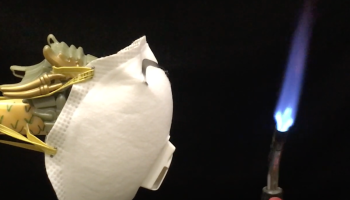
Blowing flammable lycopodium powder from a tube onto an open flame produces a fireball in a spectacular demonstration of fast reaction rates when reactants have high surface area. The purpose of this variation on the “dragon’s breath” demonstration is to illustrate that face masks can diminish the movement of particles in the air, an important idea in public health.
Video 1: Lycopodium Dragon Sneeze with a Face Mask on the author's YouTube Channel (accessed June 22, 2020)
In the demonstration, the lycopodium powder (made of spores from small plants called clubmosses) is first blown through a tube with a dragon design at one end and no flame present to illustrate the appearance of the powder puff. In this version of the demonstration, the powder is blown through the tube using a squeeze bulb from a Stomp Rocket set. Safety considerations include wearing goggles and using a fire-resistant environment (see safety links below). The tube is reloaded, but this time a face mask covers the mouth of the dragon at the end of the tube, and a propane torch is lit several centimeters away from the dragon's mouth. When the powder is blown through the tube, most of it is caught by the dust mask and no fireball forms. The “dragon sneeze” (or cough) is caught by the mask. Finally, the mask is removed, and the powder is blown through the tube into the flame to make a fireball. Here, without the mask, much more powder gets to the flame. In a similar way, NOT wearing a face mask can allow more material (including germs) to leave a person's mouth and get into the surrounding environment.
Editor's Note: This demo is an extension to the previously published article "Chemical Illustrations of Flattening the Curve".