Chemistry and the Titanic
Various items (hot dogs, bananas, flowers, racquetballs, plastic cups) show properties akin to glass when chilled in liquid nitrogen.1-4 Objects such as racquetballs and plastics behave in this manner because they are made of polymers, and polymers can become cooled below what is known as the glass transition temperature (Tg) for the polymer.3-4 Above Tg plastics are elastic, near Tg plastics lose their elasticity, and below Tg plastics become brittle (Video 1).
Video 1: SCRUB DADDY vs. LIQUID NITROGEN, Tommy Technetium YouTube Channel, October 2022.
Did you know that some metals behave in a similar fashion? Many metals display what is known as a ductile to brittle transition temperature (DBT).5-9 When a metal is hammered above its DBT, the metal absorbs the energy from the impact, which causes the metal to be deformed. Thus, a metal above its DBT can be formed into a wire or sheet. That is, the metal is ductile and malleable. On the other hand, a metal below its DBT does not absorb energy from an impact when struck. Instead, it behaves like glass (Video 2).
Video 2: Pennies vs. Liquid Nitrogen, Tommy Technetium YouTube Channel, January 2023.
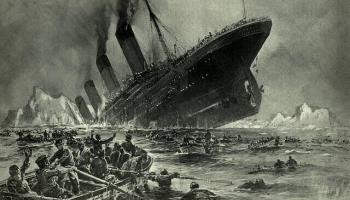
Interestingly, metals with atoms that arrange in a body centered cubic arrangement display a DBT, while metals arranging in face centered cubic or hexagonal close packed arrangements do not.6,7 Furthermore, the presence of dopants or impurities in a metal can drastically change its DBT.6-9 For example, measurements have demonstrated that higher amounts of manganese and sulfur were present in the steel used to construct the Titanic (Video 3).8,9 The presence of these elements in the steel lowered its DBT, contributing to the damage done to the Titanic on impact with the iceberg.8,9 Similar analyses of the metal used to construct the Liberty Ships has demonstrated a similar effect.6,7
Video 3: Chemistry and the Sinking of the Titanic, Tommy Technetium YouTube Channel, December 2022.
References:
- Kenneth H. Lothrop, Demonstrations in cryogenics, Journal of Chemical Education, 1978, 55, 8, 531-532.
- Lee Marek, Be Cool to Your School, Flinn Scientific.
- Thomas S. Kuntzleman, David Sellers, Rachel Hoffmeyer, "Having a Ball with Chemistry": More things to try, Journal of Chemical Education, 2008, 85, 11, 1478-1480.
- Dean Campbell,Polypropylene and the Cold Snap, ChemEd X, Feb 2021 (accessed 1/2/23)
- Rahul Wadher BEng, AMIMechE AIMMM, What is the Ductile-Brittle Transition Temperature?, ASAMS, May 2021 (accessed 1/2/23)
- Challenges 2016, 7, 20; doi:10.3390/challe7020020
- Jeremy Jordan, Ductile to brittle transitions in materials, Nov 2016 (accessed 1/2/23)
- John J. Gilman, In Defense of the Metallic Bond, Journal of Chemical Education, 1999, 76, 10, 1330-1331 (Titanic ductile brittle)
- Katherine Felkins, H. P. Leigh Jr., A. Jankovic, The royal mail ship Titanic: Did a metallurgical failure cause a night to remember? Journal of Metals, 1998, 50, 1, 12-18.
Preview image: Titanic Sinking, engraving by Willy Stöwer. https://en.wikipedia.org/wiki/

Tom Kuntzleman
I have taught science at all levels from Kindergarten through upper division undergraduate. Member of ACS, AACT.