General

Items tagged with the safety:general tag have some safety concerns that may be also described more specifically by additional safety terms

Subject

General Safety

For Laboratory Work: Please refer to the ACS Guidelines for Chemical Laboratory Safety in Secondary Schools (2016).  

For Demonstrations: Please refer to the ACS Division of Chemical Education Safety Guidelines for Chemical Demonstrations.

Other Safety resources

RAMP: Recognize hazards; Assess the risks of hazards; Minimize the risks of hazards; Prepare for emergencies
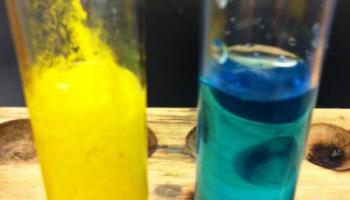
 

test tubes with sample reactions
// Wednesday, January 15, 2014 Deanna Cullen
I expect that most high school chemistry teachers assign some type of laboratory related to types of chemical reactions including synthesis, decomposition, single replacement and double replacement reactions. I have used several published versions, but I am sharing my modifications. 
// Thursday, January 9, 2014 Tom Kuntzleman
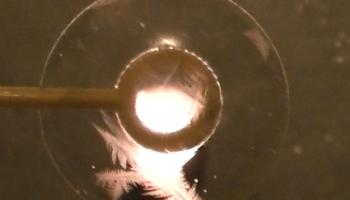
Want to try an easy, yet interesting chemistry experiment this winter? Try this: Blow some bubbles into the outside winter air and catch one of the bubbles with a bubble wand. If it is cold enough outside, the bubble will freeze! 
Preview image - title: "Ice Clouds" image includes cloud of ice in front of house.
// Monday, December 16, 2013 Tom Kuntzleman
I get excited when I see the outside temperature drop below 0°F (-18°C). This is not because I enjoy cold weather. It is because when the outside temperature gets this cold, I can conduct a particular experiment that I think is quite beautiful. The experiment is easy to carry out: boil some water and throw the hot water into the frigid air. Check it out below:
// Monday, May 13, 2013 Tom Kuntzleman
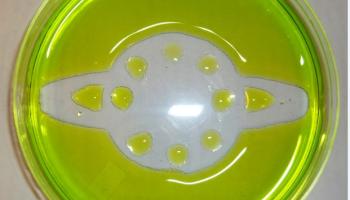
Wow! Talk about an interesting idea! A very neat experiment, called “Hydroglyphics”, has been published by Philseok Kim, Jack Alvarenga, Joanna Aizenberg and Raymond Sleeper in the Journal of Chemical Education.
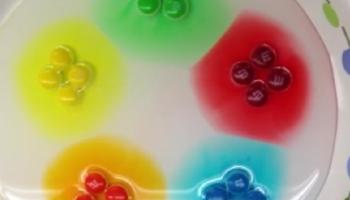
M&Ms in water on a plate
// Saturday, May 4, 2013 Tom Kuntzleman
I came across a simple, yet interesting experiment that was first described by Elizabeth Sumner Walter in 2001. She merely had students pour water into a dish containing some Gobstoppers candies.
// Tuesday, February 26, 2013 Tom Kuntzleman
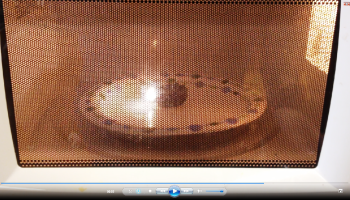
Have you ever cooked a marshmallow in a microwave? In case you are not familiar with this experiment, when a marshmallow is heated in a microwave, gases trapped in the marshmallow expand and escape. When the gas molecules escape from the marshmallow, they push against the marshmallow, causing it to expand. To see this experiment, play the video below.
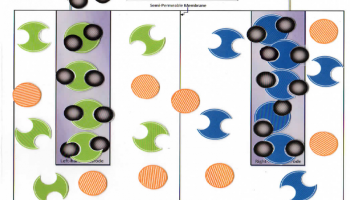
model of particle level of electrochemical cell
// Wednesday, October 10, 2012 Deanna Cullen
I was lucky enough to be part of the second cohort of Target Inquiry teachers at Grand Valley State University. As part of the program, we each wrote, tested and revised two chemistry laboratories for use at the high school level. One of mine is the lab I am sharing here.
Trendsetter Lab
// Wednesday, October 10, 2012 Deanna Cullen
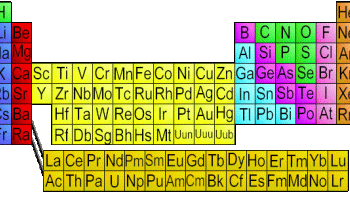
Students will proceed through a pre-lab engagement activity, organize element cards based on similarities & trends, discuss trends with the class and then produce a periodic table that includes the trends discussed within the lab. The teacher will check for student understanding at specific points as groups work together.
// Thursday, June 21, 2012 Deanna Cullen
This activity explores the relationship of the solubility of gas to temperature.