Historically, my students report significant figures as one of the most confusing concepts in honors chemistry. My recent blog post described the process of transforming my introduction into an inquiry activity.
ENGAGE: A “Buzzing” Introduction to Significant Figures
Education “buzz words” can be meaningless jargon, or they can challenge us to consider new approaches to teaching and learning. Don’t let the jargon be a buzz kill!
The Great Lakes Bioenergy Research Center offers educational programs for teachers and students. Teachers may apply for a 7-week bioenergy research opportunity in which they also develop curriculum to bring back to their classrooms. The programs runs from June 22 - Auust 7 and offers a $7000 stipend. Deadline to apply March 20, 2015.
This workshop is intended to provide the teacher with tools, strategies and resources to help them meet the challenges of implementing NGSS.
Held in Washington D.C. on March 26 & 27, 2015.
Project 2061 is a long term initiative of the American Association for the Advancement of Science (AAAS) focused on improving science education. Among other things, Project 2061 produces assessment items and concept inventories to support science educators.
Project 2061 is currently recruiting teachers to field test multiple choice tests relating to energy. Students must be enrolled in grades 4 through 12.
Deadline to apply is March 31, 2015.
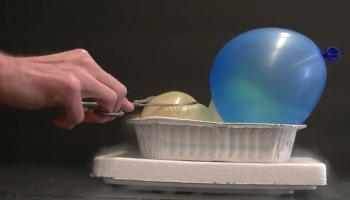
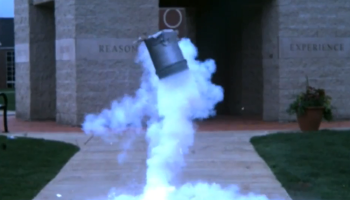
Conducting experiments with liquid nitrogen experiments is a sure-fire way to energize many chemistry lessons. Unfortunately, getting access to liquid nitrogen can be a bit difficult. I happen to purchase liquid nitrogen from Airgas; you might be able to find a branch near you here.
The CELA Scholarship is offered to help first-time attendees and presenters develop their knowledge and skills in chemical education, the ChemEd 2013 Conference committee has sponsored the 2015 ChemEd Legacy Award (CELA) Scholarship Program. The scholarship program will cover the registration fee for more than 12 first-time ChemEd attendees and more than 12 first-time speakers/presenters.
The founders of the Hach company established the Hach Scientific Foundation in 1982. One of the programs that has emerged from this foundation is the High School Chemistry Grant Program. This grant is available to high school chemistry teachers. Teachers that have ideas to improve the teaching and learning of chemistry in their classrooms are encouraged to apply. Teachers are given up to $1500 for their ideas. The 2015 application cycle begins February 1st and runs until April 1.
This biennial conference is the largest of its kind, bringing together dedicated educators involved in high school and introductory chemistry from across the North America. Educators are immersed in a setting facilitating collaboration, support, the exchanging of ideas, and inspiration over a period of five days.
Happy New Year! Did you know that 2015 is the International Year of Light (IYL)? IYL is a “global initiative adopted by the United Nations to raise awareness of how optical technologies promote sustainable development and provide solutions to worldwide challenges in energy, education, agriculture, communications and health1”. IYL is sponsored by several organizations with interests in science and science education, including the European Physical Society, the Institute of Physics, the American Physical Society, and the American Institute of Physics. You can find several lesson plans, videos and other educational resources on the IYL website2.