Blogs

ChemEd X contributors offer their ideas and opinions on a broad spectrum of topics pertaining to chemical education.

Blogs at ChemEd X reflect the opinions of the contributors and are open to comments. Only selected contributors blog at ChemEd X. If you would like to blog regularly at ChemEd X, please use our Contribution form to request an invitation to do so from one of our editors.

blog

// Tuesday, March 10, 2015 Sarah Kong
Labs! They have been the most overwhelming part of my career in chemistry. I felt the least prepared in this area when I began teaching and walked into my first lab as a teacher. Knowing all of the chemicals and equipment were under my care was a bit terrifying.
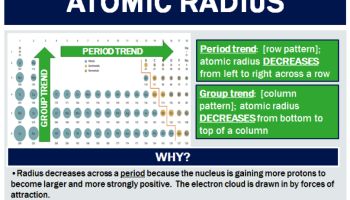
Atomic Radius ppt
// Tuesday, March 3, 2015 Allison Tarvin
In this age of scientific inquiry, molecular modeling, digital classrooms, and differentiation, I felt downright guilty about any teacher-centered time. My classroom is flipped after all. I’m not supposed to be lecturing, right?
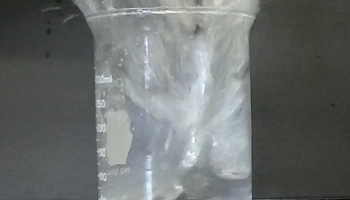
Sealed carbon dioxide exploding
// Tuesday, March 3, 2015 Tom Kuntzleman
A fun experiment to conduct when discussing phase diagrams is the melting of solid carbon dioxide (dry ice).  To perform this experiment, place small pieces of dry ice (carbon dioxide) in a plastic pipette, seal with a pair of pliers, and position the bulb of the sealed pipette in a beaker of water.  Then sit back and watch what happens! 
// Thursday, February 26, 2015 Dan Meyers
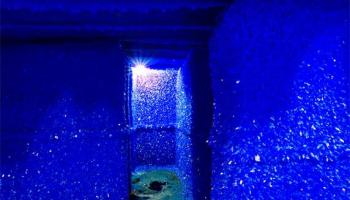
Last year I came across a link on Twitter regarding an art installation by Roger Hiorns in England titled “Seizure.” Some of you may have seen it too – a condemned flat in London was essentially sealed off and filled with more than 75,000 L of supersaturated copper sulfate solution.
modeling training
// Tuesday, February 24, 2015 Deanna Cullen
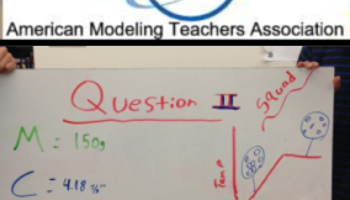
I was taught science by transmission. The content information was provided and I did my best to make sense of it. If some of the material didn’t make sense, I could just memorize it for the test. As a new teacher in the late 1980’s, I wanted to offer my students more.
Flasks showing transition colors
// Tuesday, February 24, 2015 LowellThomson
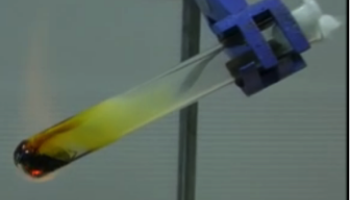
Just the other day within my IB Chemistry HL classes, we were discussing the color of transition metal complex ions in solution. It's a bit imperfect, because they are not yet dissolved, but I set up a number of metal chloride salts in order to help students see the pattern.
camera
// Wednesday, February 18, 2015 Kevin Conkel
I teach AP chemistry and general chemistry at Hudsonville High School in the Grand Rapids area.  I applied for the HACH grant last spring and was very excited when I was one of the recipients that was accepted.  The process of applying is very easy.
scantron and pencil
// Tuesday, February 17, 2015 Deanna Cullen
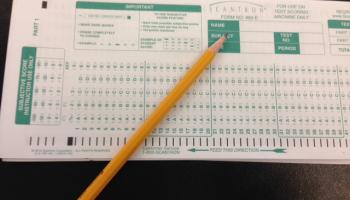
The new AP Chemistry Curriculum and the NGSS both focus on developing deep conceptual understanding. In order to achieve this, teachers must identify the objectives they need to teach to and stockpile a good assortment of conceptual questions for formative and summative assessments to support those objectives.
Balloon cooled in liquid nitrogen
// Tuesday, February 17, 2015 Tom Kuntzleman
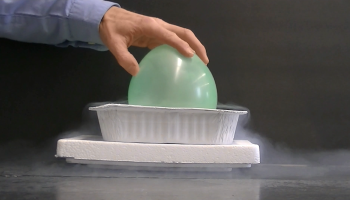
Did any of you guess what was going on in Chemical Mystery #4:  The Case of the Misbehaving Balloon?  In this experiment, several balloons were placed in liquid nitrogen.  Most of these balloons shrunk tremendously – to almost zero volume – when cooled