Endothermic and Exothermic Activity
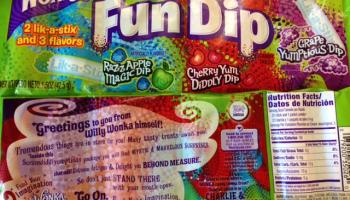
Endothermic and exothermic reactions and processes are a common topic in chemistry class. This activity provides examples that can be done with household materials.
Materials
Pixie Stix candy (or other powdered candy containing citric acid…like Fun Dip), chunks of potato, 3.5% H2O2 (hydrogen peroxide), H2O, thermometers.
Background
1. Define endothermic reaction and exothermic reaction.
2. Why is citric acid commonly found in candy?
3. Research the decomposition of hydrogen peroxide and catalysts of that decomposition. Write the decomposition reaction here.
4. Read through the procedure. Using a separate piece of paper, prepare a data table to record all the required information. This pre-lab will be checked by the teacher before you will be allowed to begin the lab.
5. Predict the results of the reactions.
Procedure
1. Obtain 2 test tubes. Label one A and the other B.
2. Add 10 ml of H2O to test tube A and record the temperature.
3. Add 2 grams of candy to test tube A. (The solid does not all need to dissolve.) Record the temperature every 10 seconds until the temperature is constant for 3 recorded temps. Record any other observations you notice.
4. Add 10 ml of H2O2 to test tube B and record the temperature.
5. Add 2 grams of potato to test tube B. Record the temperature every 10 seconds until the temperature is constant for 3 recorded temps. Record any other observations you notice.
Questions
- Explain the transfer of energy that takes place in each reaction system.
- Citric acid and water?
- Hydrogen peroxide and potato?
- Citric acid and water?
- Identify if the reactions observed were endothermic or exothermic.
- Citric acid and water?
- Hydrogen peroxide and potato?
- Citric acid and water?
- Optional: Consider the results of this activity. Identify a question that you can explore with the same materials. Write a procedure and create a data table in preparation.
Concepts
endothermic reactions, exothermic reactions
Time Required
20 minutes
Preparation
10 minutes to get out test tubes, thermometers and candy.
Attribution
You can find several examples of these reactions in a google search. One example is at the Beyond Benign Web site.
Credits
General
Items tagged with the safety:general tag have some safety concerns that may be also described more specifically by additional safety terms
General Safety
For Laboratory Work: Please refer to the ACS Guidelines for Chemical Laboratory Safety in Secondary Schools (2016).
For Demonstrations: Please refer to the ACS Division of Chemical Education Safety Guidelines for Chemical Demonstrations.
Other Safety resources
RAMP: Recognize hazards; Assess the risks of hazards; Minimize the risks of hazards; Prepare for emergencies

Deanna Cullen
High School Editor for ChemEd X, 25+ veteran HS chemistry teacher, GVSU Target Inquiry Program, trained in Modeling InstructionTM, GVSU Visiting Faculty, 2015 MSTA High School Science Teacher of the Yea