
Vapor Pressure: Molecular Size
The measurement of pressure exerted by a vapor is demonstrated using barometers. Vapor pressure varies with the strength of the intermolecular forces in the liquid.
Pentane, hexane and heptane
The vapor pressures of pentane, hexane and heptane are compared. Pentane, hexane and heptane differ only in the length of their carbon chain, and have the same type of intermolecular forces, namely London dispersion forces. London forces increase with molecular size (number of electrons in a molecule). The London forces between the smaller pentane molecules are much weaker than the forces between the larger heptane molecules. Therefore pentane has the largest vapor pressure and heptane has the smallest vapor pressure.
Methanol and ethanol
The vapor pressures of methanol and ethanol are compared. Methanol and ethanol have similar structures and similar intermolecular forces, but differ in molecular size. Methanol has the higher vapor pressure because its molecules are smaller than those of ethanol, and so its intermolecular forces are less than ethanol's.
(137 )
Keywords
vapor pressure, atmospheric pressure, barometric pressure, barometer, intermolecular forces, gases and liquids, organic, phase changes, physical properties
Multimedia
 _Play
movie (1 minute 33 seconds, 4 MB)
_Play
movie (1 minute 33 seconds, 4 MB)
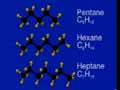
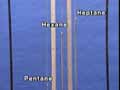
Pentane, hexane and heptane
Pentane, hexane and heptane differ only in the length of their carbon chain, and have the same type of intermolecular forces, namely dispersion forces. Dispersion forces increase with molecular weight.
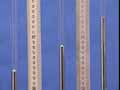
Pentane, the smallest of the three, is injected (into the open end of the barometer, it rises to the top) and vaporizes. Here, the mercury is depressed from 730 to 285 millimeters. When hexane is injected, the hexane rises to the top and vaporizes. Here, the mercury is depressed to 596 millimeters. When heptane, the biggest of the three, is injected, the heptane rises to the top and vaporizes. Here, the mercury is depressed to only 686 millimeters.
The dispersion forces between the smaller pentane molecules are much weaker than the forces between the larger heptane molecules. Therefore pentane has the largest vapor pressure and heptane has the smallest vapor pressure.
 _Play
movie (1 minute 5 seconds, 2.1 MB)
_Play
movie (1 minute 5 seconds, 2.1 MB)

Methanol and ethanol
Methanol and ethanol have similar structures and similar intermolecular forces, but differ in molecular weight. Which has the higher vapor pressure?
When methanol is injected, the methanol rises to the top and vaporizes. The mercury column is depressed to 634 millimeters. (Errata, the voiceover erroneously states that reading is 640 millimeters.) When ethanol is injected, the ethanol rises to the top and vaporizes. Here, the mercury column is only depressed to 688 millimeters.
Methanol has the higher vapor pressure because its molecular weight is less than ethanol and so its intermolecular forces are less than ethanol's.
Discussion
The magnitude of London dispersion forces depends on the polarizability of a molecule, that is, the ease with which the molecule's electron cloud can be distorted. The bigger the molecule is and the more electrons it has, the bigger the London forces are. Bigger molecules usually have larger molecular weights; hence the correlation of vapor pressure with molecular weight.