
Vapor Pressure of a Mixture: Raoult's Law
The measurement of pressure exerted by a vapor is demonstrated using barometers. Vapor pressure varies with the strength of the intermolecular forces in the liquid.
In this section we will look at vapor pressure of mixtures. We can calculate the vapor pressure of a mixture using Raoult's law.
First we wil consider a solution that contains 0.6 mole fraction of decane and 0.4 mole fraction of diethyl ether.
Second we wil consider a solution that contains 0.3 mole fraction of decane and 0.7 mole fraction of diethyl ether.
(137 )
Keywords
vapor pressure, atmospheric pressure, barometric pressure, barometer, intermolecular forces, Raoult's law, gases and liquids, organic, phase changes, physical properties
Multimedia
 _Play
movie (1 minute 43 seconds, 4.4 MB)
_Play
movie (1 minute 43 seconds, 4.4 MB)

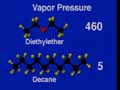
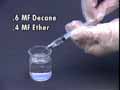
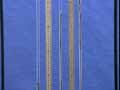
When diethyl ether is injected (into the open end of the barometer), the diethyl ether rises to the top and some vaporizes. The mercury is depressed to 275 millimeters. (The difference between the mercury levels before and after enjection is the vapor pressure.) Here, the vapor pressure of diethyl ether is 460 millimeters of mercury.
Let's look at how the vapor pressure will change when ether is mixed with another liquid such as decane, which has a vapor pressure of 5 millimeters of mercury.
If we take a solution that contains 0.6 mole fraction of decane and 0.4 mole fraction of diethyl ether and inject it into the barometer, it depresses the mercury to only 552 millimeters. Therefore the vapor pressure of the solution is 183 mm, in between the vapor pressure of pure decane or pure ether.
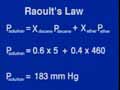
We can calculate the vapor pressure of a mixture using Raoult's law. Here, for decane, we multiply the mole fraction, which is .6, by the vapor pressure, which is 5. For diethyl ether, we multiply the mole fraction, which is .4, by the vapor pressure, which is 460. Adding these gives us a vapor pressure of 183 millimeters.
Another example
 _Play
movie (32 seconds, 0.9 MB)
_Play
movie (32 seconds, 0.9 MB)
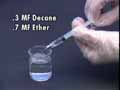
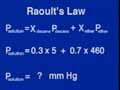
Another solution contains 0.3 mole fraction of decane and 0.7 mole fraction of diethyl ether. Using Raoult's law, will the vapor pressure of solution depress the mercury more or less than the previous one?
 _Play
movie (20 seconds, 1.2 MB)
_Play
movie (20 seconds, 1.2 MB)

This mixture is injected, and the mercury is depressed to 415 millimeters. This solution, which has a higher mole fraction of ether than the previous one, has a higher vapor pressure. However, the mercury is not depressed as much as the ether, because the vapor pressure of decane still contributes to the total vapor pressure (as stated in Raoult's law).
Discussion
The sample of pure ether is refered to incorrectly as "the pure solution of ether" in the voice over. Diethyl ether is labeled incorrectly as "Diethylether" in the video labels.