
Thermochromism: Mercury(II) Iodide
When red-orange Mercury(II) Iodide (HgI2) is heated, it undergoes a phase transition at 126oC to a pale yellow form. As the heated sample cools, it gradually returns to the original red-orange color.
(130 )
Keywords
activation energy, phase changes, physical properties, solid state, solids and liquids, bonding
Multimedia
 _Play
movie (42 seconds, 2.3 MB)
_Play
movie (42 seconds, 2.3 MB)
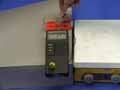



Mercury (II) iodide below 126oC is red/orange in color. This is referred to as the alpha form. Mercury (II) iodide is a thermochromic compound. That is, its color changes as heat is applied. The color change is due to a change in crystal structure. At temperatures above 126oC, mercury (II) iodide exists in its beta form, which is pale yellow.
_Play
movie (37 seconds, 1.9 MB)
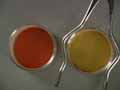
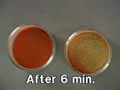
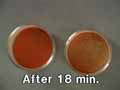
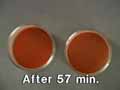
When the beta form cools to below the transition temperature of 126oC, it returns to the red/orange alpha form.
Discussion
See the topic Thermodynamic vs Kinetic Control Forming Mercury(II) Iodide on Chemistry Comes Alive! Volume 1 for another experiment involving these two phases of HgI2.
Additional still images for this topic
Demonstration Notes: Warnings, Safety Information, etc.
Exam and Quiz Questions
1. What causes the mercury (II) iodide to change color?