
Memory Metal
When a piece of metal wire spelling the letters ICE is pulled apart, it deforms. When the wire is placed in hot water, it "remembers" its original shape, once again forming the letters ICE. (The memory metal used in this demonstration was provided by the Institute for Chemical Eduction.) A simulation of the processes at the atomic level is shown.
(96 )
Keywords
crystal lattice, phase changes, physical properties, metals, solid state, solid state structures, solids and liquids, bonding, real life/environment, practical applications, d block, transition elements
Multimedia
 _Play
movie (40 seconds, 2.5 MB)
_Play
movie (40 seconds, 2.5 MB)
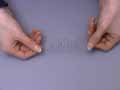
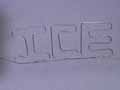
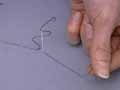

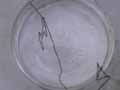

Memory metal is a nickel-titanium alloy. This piece has been formed into the letters ICE, heat-treated, and cooled. When the memory metal is pulled apart, it deforms. When placed into hot water, the metal "remembers" its original shape, and again forms the letters ICE.
Animation
 _Play
movie (18 seconds, 1 MB)
_Play
movie (18 seconds, 1 MB)




Upon cooling, the ordered austenite phase transforms to martensite, which is easily deformed. Reheating the martensite causes a phase transformation to austenite, and the metal "remembers" its original shape.
Austenite Crystal Structure
Martensite Structure
Discussion
Austenite is the phase of NiTi stable at high temperature, while martensite is more stable at room temperature. Although austenite is the less dense phase, it is more rigid than martensite. At room temperature, the metal is in the martensite phase. When pressure is applied, the metal atoms easily slide by one another, and the shape changes. Heating the metal to about 50oC changes it to the rigid austenite phase. The dislocations between the crystalline grains of the metal (see topic "Simulation of Dislocations in Metals") will return to their original positions, and the metal will "remember" its original shape. Upon cooling, the metal returns to the martensite phase, but will retain its shape until pressure is applied.
To provide it with a new memory, the metal must be held in a new shape and heated to about 500oC (where there is enough energy to allow the defects to relax into new positions) and then slowly cooled. This is an annealing process, similar to the one demonstrated in the topic "Heat Treatment of a Metal Bobby Pin".
Additional still images for this topic
Demonstration Notes: Warnings, Safety Information, etc.
Exam and Quiz Questions
1. What causes the metal to return to its original shape?