
Liquefaction of Carbon Dioxide
Dry ice is placed into an acrylic plastic cylinder. A valve is closed and pressure in the cylinder increases. When the pressure reaches 350 kPa (50 psi) it stops increasing and liquid CO2 appears. The liquid begins to boil and when all solid CO2 is gone, the pressure increases further. The valve is opened and the pressure drops again, holding constant for a while at 350 kPa. Eventually solid CO2 reforms, the liquid disappears, and the pressure drops completely. An animation of this process superimposed on a phase diagram follows.
(107 )
Keywords
sublimation, gas laws, pressure, phase diagram, triple point, solids and liquids, gases, phase changes, physical properties, gases and liquids
Multimedia
Part 1 of 4
 _Play
movie (40 seconds, 2.4 MB)
_Play
movie (40 seconds, 2.4 MB)
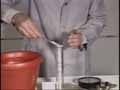
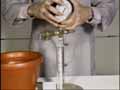
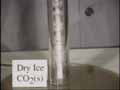
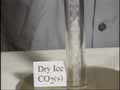
Ordinarily carbon dioxide or dry ice sublimes, that is it passes directly from the solid to the vapor form. But under high pressure conditions, carbon dioxide can be caused to liquefy. Here some dry ice is placed into a strong plastic tube and a pressure gauge is screwed onto the top of the tube. A valve on one side of the gauge is open at the beginning, so the pressure inside the tube is the same as the atmospheric pressure outside.
Part 2 of 4
 _Play
movie (1 minute, 3.3 MB)
_Play
movie (1 minute, 3.3 MB)
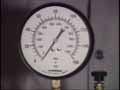
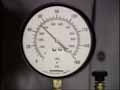
When the valve is closed, the pressure in the tube begins to build up. The pressure rises steadily until the gauge reads about 350 kilopascals.
At this point the pressure stops increasing and the dry ice in the tube begins to melt and form liquid at the very bottom of the tube. There is also some gas being given off from the liquid and the liquid appears to be boiling. Once most of the solid is gone, the pressure begins to rise again on the pressure gauge. To review: the pressure rises until there is an equilibrium between solid, liquid, and gaseous carbon dioxide, and then it holds steady.
Part 3 of 4
 _Play
movie (24 seconds, 1.6 MB)
_Play
movie (24 seconds, 1.6 MB)
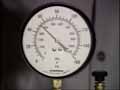
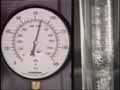
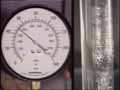
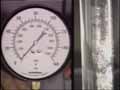
Once all of the solid has melted, the pressure rises farther. When the valve on the pressure gauge is opened, the pressure drops back down to 350 kilopascals. The liquid begins to boil quite rapidly and solid begins to form. When most of the liquid has changed to solid, the pressure drops back down to normal atmospheric pressure.
Part 4 of 4 - Animation
 _Play
movie (28 seconds, 1.2 MB)
_Play
movie (28 seconds, 1.2 MB)
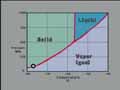
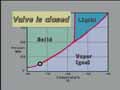
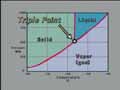
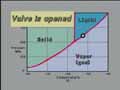
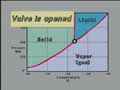
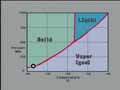
On the CO2 phase diagram, the marker is originally on the solid-vapor equilibrium line. As the pressure and temperature rise, the triple point is reached. Once all the solid has been converted to liquid, the pressure rises again. When the valve is opened, the point on the phase diagram drops back to the triple point. holds there as the liquid is converted to solid, and eventually drops back to atmospheric pressure.
Discussion
Note that the gauge pressure is 350 kPa, which corresponds to an absolute pressure of 450 kPa. The triple point of pure CO2 occurs at a pressure of ~500 kPa. The gauge is either inaccurate, or there are impurities in the sample.
Because there is always a transformation occuring from one phase to another, the voice-over and text for part 2 of this demonstration would be improved if the last sentence read "To review: the pressure rises until all three phases, solid, gas, and liquid are present, and then it holds steady."
Additional still images for this topic
Demonstration Notes: Warnings, Safety Information, etc.
Exam and Quiz Questions
Live Video
1. What happens to the carbon dioxide when the gauge reads 350 kPa? Name all phases of CO2 present at this gauge pressure. What term is given to this point?
2. List as many observations as possible concerning this video segment.
3. Use a phase diagram to explain why the pressure increases, then holds steady, then increases again.
Animation
1. What is the absolute pressure at the triple point of carbon dioxide?
2. When the pressure gauge is opened, to what absolute pressure does the system initially fall? What happens to the carbon dioxide at this point?
3. To what absolute pressure does the system return once the liquid CO2 has been reconverted to solid?