
Boiling by Cooling
A flask contains water and water vapor at 100oC. Each time ice water is poured over the outside of the flask, the water inside the flask boils. Although the temperature of the water in the flask has decreased, in each instance boiling is observed.
Keywords
vapor pressure, equilibrium, phase changes, physical properties, gases and liquids, solids and liquids, gases, gas laws
Multimedia
 _Play
movie (45 seconds, 2.7 MB)
_Play
movie (45 seconds, 2.7 MB)
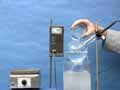
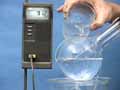
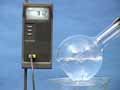
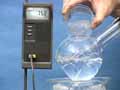
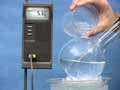
Water boils in a flask, and later the flask is stoppered and
removed from the hot plate. When ice water is poured over the
flask, the water begins to boil. When the flask is cooled, the
pressure of the water vapor decreases, which decreases the boiling point of the water. Note also that the temperature of the water in
the flask decreases in the process. Ice water may be poured over
the flask several times as the water cools. Boiling occurs each
time ice water is poured over the flask.
(92 )
 _Play
movie (24 seconds, 1.1 MB)
_Play
movie (24 seconds, 1.1 MB)
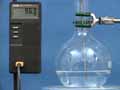
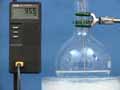
When ice is brought to the bottom of the flask, the liquid in the
flask is cooled. The liquid does not boil.
(111 )
Discussion
Initially, the liquid and vapor phases of the water are in equilibrium. When ice water is poured over the top of the flask, the vapor cools more rapidly than the liquid. After cooling, the pressure of the vapor phase is less than the vapor pressure of the liquid, so the liquid will boil until the pressure of the vapor increases to the vapor pressure of the liquid. At a location such as Denver, where atmospheric pressure is lower than a sea level, water boils below 100oC for the same reason as in this demonstration.
Additional still images for the first part of this chapter
Additional still images for the second part of this chapter
Demonstration Notes: Warnings, Safety Information, etc.
Exam and Quiz Questions
1. Explain why pouring ice water over the flask makes water boil.
2. Does pouring ice water over the flask increase, decrease or leave unaffected the pressure of the water vapor in the flask?
3. What might be the effect if 100 oC water were poured over the flask? Would the water inside boil?
4. Why doesn't the boiling process build up sufficient pressure to pop the stopper off the top of the flask?